Trading Glossary
Forex and gold trading terms in plain English: liquidity sweeps, BOS, CHoCH, pips, lots, R-multiples, swap and more.
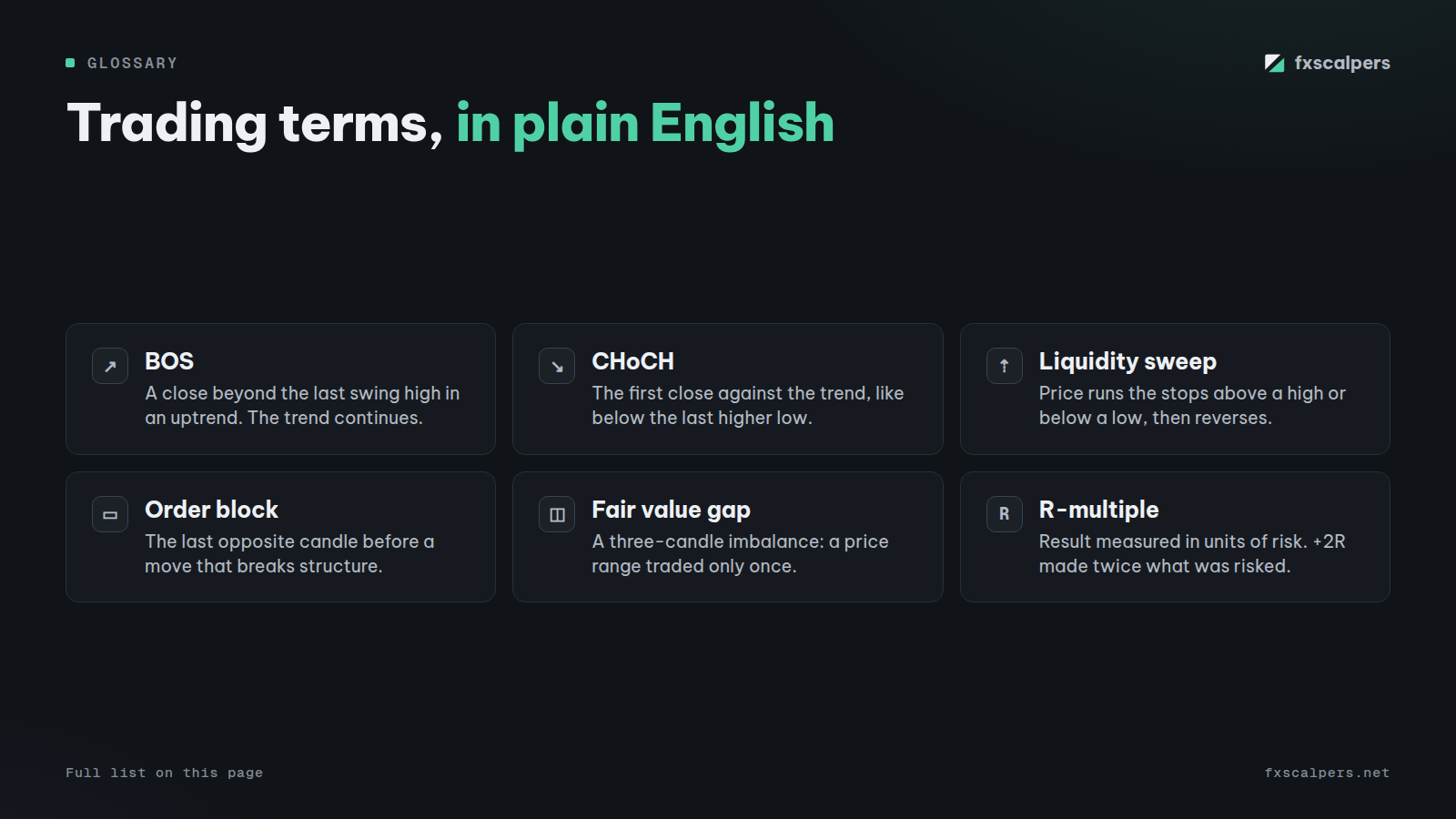
Plain-English definitions of the terms used across FXScalpers setups, plans and articles. Each one links to the article that explains it in practice.
ATRAverage True Range. The average size of recent candles, used to measure volatility and size stops. Read moreAsian rangeThe high and low printed during the Asian session. London often tests one side of it. Read moreBiasThe direction you expect the market to favor, taken from higher-timeframe structure. Read moreBOS (break of structure)A candle closing beyond the last swing high in an uptrend (or low in a downtrend), confirming the trend. Read moreBreakeven stopMoving the stop to the entry price. Done too early, it turns good trades into scratches. Read moreCHoCH (change of character)The first break against the trend, such as a close below the last higher low in an uptrend. Read moreCommissionA fixed fee per lot charged on Raw or ECN accounts, on top of a tighter spread. Read moreDrawdownThe drop from an account’s peak to its lowest point before a new peak. Read moreEntry zoneThe price area where a setup becomes valid. Waiting for it is how you avoid chasing. Read moreEqual highs / equal lowsTwo or more swing points at nearly the same price. Stops cluster just beyond them. Read moreInvalidation levelThe price that proves a trade idea wrong. It is where the stop belongs. Read moreLeverageHow large a position your broker lets you open relative to your margin. It does not set your risk. Read moreLiquidityClusters of resting orders, especially stops, that large players need in order to fill size. Read moreLiquidity sweepPrice pushing through a cluster of stops and closing back on the other side. Read moreLotThe unit of position size. 1 standard lot is 100,000 units of a currency pair or 100 ounces of gold. Read moreMarginThe money your broker sets aside to hold an open position. Read moreNecklineThe low between the two tops of a double top (or the high between two bottoms). Read moreNFPNon-Farm Payrolls, the monthly US jobs report and one of the biggest movers of gold. Read moreOrder blockThe last opposite candle before a move that breaks structure and leaves an imbalance. Read morePipThe standard price step of a currency pair, 0.0001 for most pairs and 0.01 for JPY pairs. Read morePosition sizeHow many lots you trade, calculated from your risk and your stop distance. Read moreR (R-multiple)Profit or loss measured in units of the amount you risked. Risking $50 and making $100 is +2R. Read moreRebatePart of the trading fees returned to the trader per lot traded. Read moreRolloverThe daily end of the trading day at 17:00 New York time, when swaps are charged and spreads widen. Read moreSession overlapThe hours when London and New York are both open, the most liquid window for gold. Read moreSlippageThe difference between the price you clicked and the price you were filled at. Read moreSpreadThe gap between bid and ask, paid every time you open a trade. Read moreSqueezeA period of unusually low volatility, visible as tightly pinched Bollinger Bands. Read moreStop levelThe minimum distance your broker allows between price and a stop or target. Read moreSwapThe overnight financing charge or credit for holding a position past rollover. Read moreTiltTrading on emotion after losses or big wins, usually with bigger size and looser rules. Read moreVWAPVolume-weighted average price since the session open. On spot gold it uses broker tick volume. Read more