Spreads at rollover: why you got stopped out at 21:00 UTC
Every day there is a window where spreads on gold jump several times over. What happens at rollover, and how to protect held trades.
Every trading day has a window where the spread on gold and the majors can jump several times over its normal level. It isn’t news, and it isn’t a broker glitch. It’s the daily rollover, and scalpers who don’t know about it get stopped out for no visible reason, then spend the evening convinced their broker hunted them.
The short version
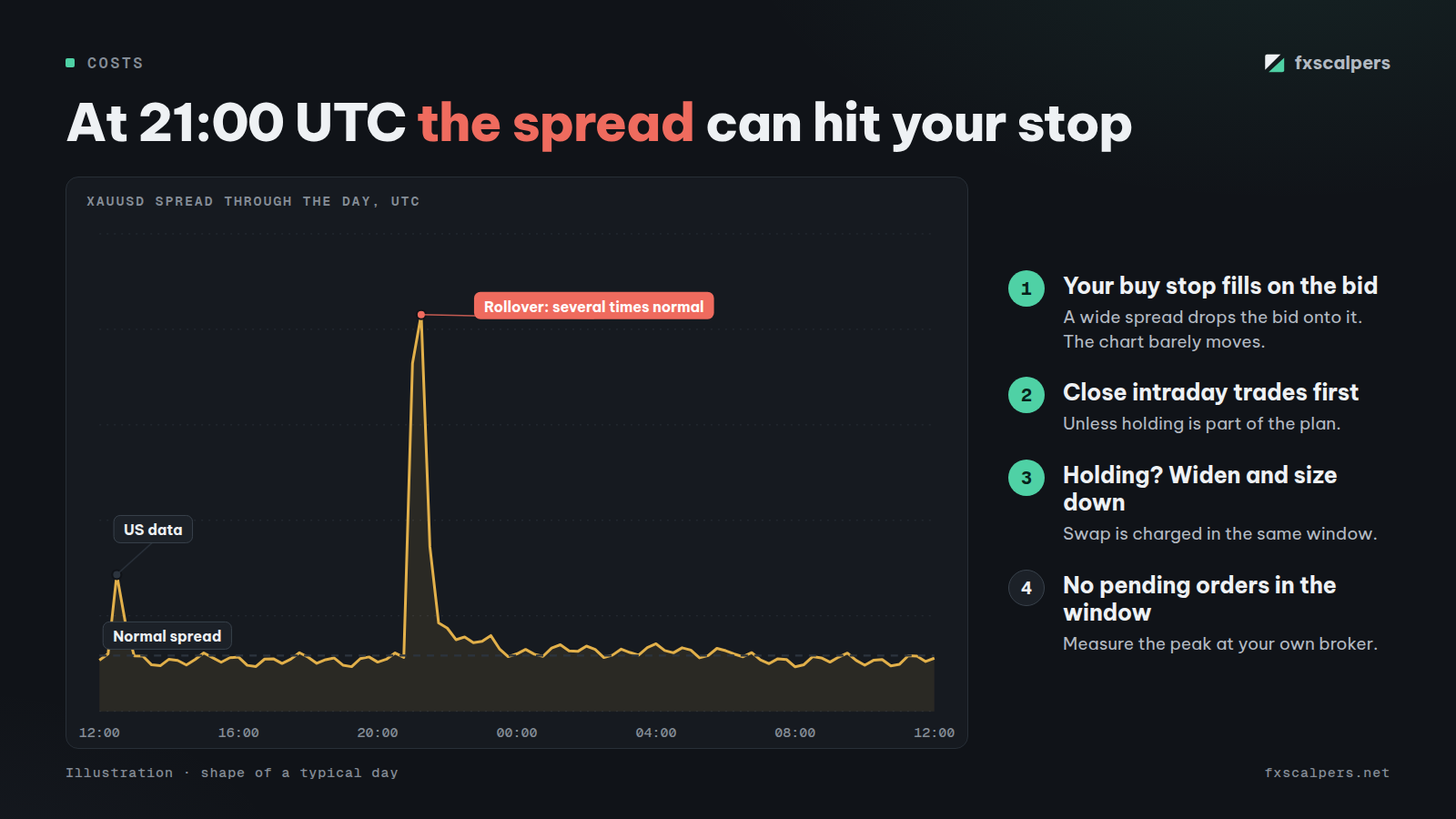
- Around 17:00 New York time (21:00 UTC in summer, 22:00 in winter) the trading day ends and liquidity thins out for a short while.
- Spreads widen, sometimes dramatically on gold. Buy stops trigger on the bid, so a wide spread can hit your stop while the chart barely moves.
- Close intraday trades before the window, or hold with a stop wide enough and a size small enough to survive it. No new pending orders inside it.
What happens at rollover
At the end of the New York session, open positions roll to the next value date. Banks and liquidity providers settle, reset and update their pricing. For a few minutes, and sometimes longer, many of them step back from quoting. The order book thins out, and when fewer participants are quoting, the gap between the best bid and the best ask gets wider.
On EUR/USD a spread that sits at a fraction of a pip all day might briefly show several pips. On gold, a spread that normally sits at a few tenths of a dollar can jump to a few dollars for a short time. Same broker, same account, same symbol. Just a different minute of the day.
Why it stops you out
MT5 charts are drawn from the bid price. Positions close on the opposite side:
- A buy closes at the bid. Its stop loss triggers when the bid falls to the stop.
- A sell closes at the ask. Its stop loss triggers when the ask rises to the stop.
Sells are the ones that get hurt invisibly. When the spread widens, the ask jumps up while the bid, and therefore the chart, barely moves. A sell stop sitting a little above the price can be triggered by the ask alone. You look at the chart the next morning and price never came close to your stop. On the ask side, it did.
Buys aren’t immune either: spreads often widen in both directions, pushing the bid down as well. Stops placed a few pips from price are especially exposed.
A worked example
You’re short gold at 2,341.20 with a stop at 2,343.00, $1.80 away. Normal spread: $0.25. At 21:02 UTC the spread jumps to $2.20 for about ninety seconds. The bid on your chart sits near 2,341.00, but the ask is now around 2,343.20. Your stop triggers at 2,343.00, plus slippage. By 21:10 the spread is back to normal and the chart shows price never went above 2,341.50. The loss is real, and it came entirely from the spread.
How to protect yourself
- Close intraday trades before the rollover window if holding isn’t part of the plan. For most scalpers, the trading day should end well before it.
- If you must hold, keep the stop wide enough to survive the spread widening, and size the position down to keep the dollar risk the same. The lot size calculator handles the math.
- Don’t place new pending orders that could trigger during the window. A buy stop entry can fill at a terrible price on a spread spike.
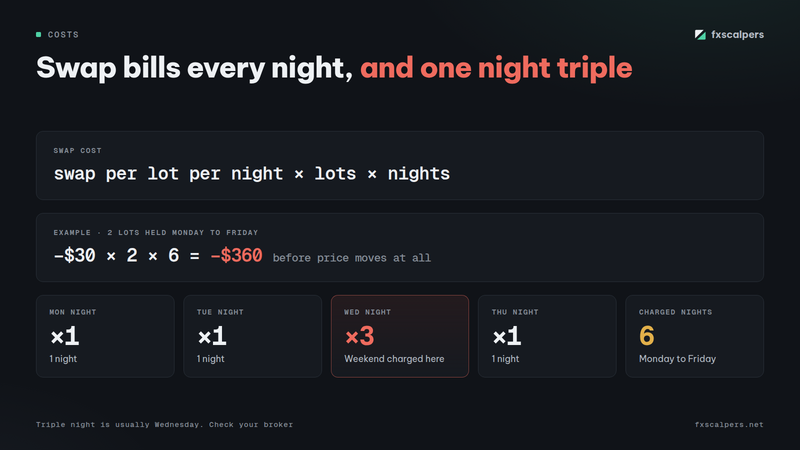
- Remember swap is charged at the same moment. See swap on gold for the overnight cost.
- Avoid tight trailing stops into the window. A trailing stop that’s perfect at 18:00 UTC can be pure spread bait at 21:00.
Measure it at your broker
Every broker and account type behaves differently at rollover. Watch the spread on your broker’s gold symbol through the rollover for a few days and note the peak and how long it lasts. In MT5, add the spread to the Market Watch window or use a free spread indicator on the M1 chart. That number tells you how much room a held position really needs.
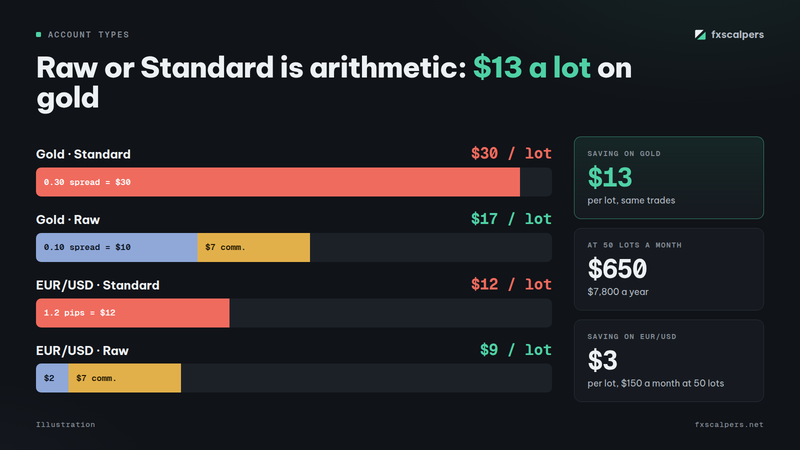
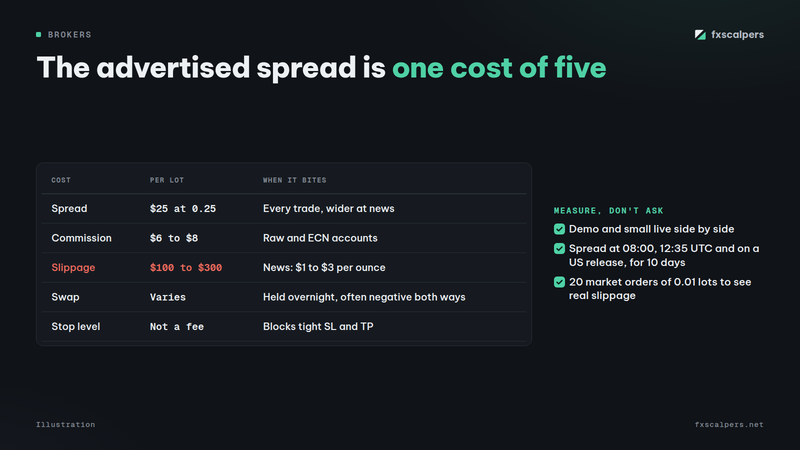
It’s also a great way to compare brokers. A broker whose gold spread stays reasonable at rollover and during news is worth more than one advertising “from 0.0” for the quietest minute of the day. Choosing a gold broker covers the full list of costs to check.
It’s not the only wide-spread window
- The first minutes after US data such as CPI and NFP: spreads blow out while market makers pull quotes. Read the calendar before the session.
- The weekly open on Sunday evening: thin liquidity, gaps and wide spreads.
- Friday afternoon in New York: liquidity drains into the weekend.
- Holidays when one major center is closed.
Quick FAQ
Is my broker cheating when this happens?
Not by itself. Rollover widening is industry-wide. What separates brokers is how much and for how long. Measure it, compare, and choose accordingly.
Does this affect EUR/USD too?
Yes, though usually less in dollar terms. Crosses and exotic pairs are often worse than the majors.
Can I just remove my stop during rollover?
No. A position without a stop through a thin market is exactly how small accounts disappear on a gap. Widen and size down, or close.
Traps to avoid
- Blaming “stop hunting” and moving stops even tighter. That makes the problem worse.
- Scalping into the last hour of New York because “there’s still time”. The best window for gold ended hours earlier. See the best time to trade gold.
- Forgetting daylight saving: the window moves one hour in UTC when New York changes its clocks.
Setups in the Free channel are timed around the liquid windows, and news alerts flag the hours when spreads are dangerous. Join and trade the hours that pay, not the minutes that cost.