How to read the economic calendar as a scalper
Filter it down to what moves gold, read the surprise instead of the number, and four news rules that keep spreads from eating you.
The economic calendar lists dozens of releases every week. A scalper needs to care about a handful of them, and needs to know them precisely: the exact time, the currency, and what usually happens to spreads when they hit. Here’s how to read it without drowning in it, and how to turn it into three or four hard rules.
The short version
- Filter to high-impact events for the currencies you trade. For gold, that means USD first.
- Read the surprise: actual minus forecast. The forecast is already in the price.
- No new trades 15 minutes before a high-impact release, a decision in advance for open trades, and hands off until spreads normalize.
Filter it down
- Only high-impact events for the currencies you trade. Most calendars rate events low, medium or high. For gold, that means USD above all. For EUR/USD, USD and EUR. For GBP/USD, add GBP.
- Set the calendar to your own time zone, or to UTC, and never mix the two. Half the “the news caught me” stories are time zone mistakes.
- Look at the week on Sunday. Know the danger days before the first trade. Mark them in your plan.
The releases that move gold
- US CPI: inflation data. Directly shifts rate expectations, and gold reacts hard. Why gold spikes on CPI.
- Non-Farm Payrolls (NFP): the monthly jobs report, usually on the first Friday of the month. Comes with the unemployment rate and wage growth, which can disagree with the headline.
- FOMC decisions and press conferences: the Fed rate decision, plus the tone of the press conference afterwards, which can reverse the first move. Lands late in the European day.
- US GDP, PCE, retail sales and ISM: secondary, but still capable of a sharp spike, especially when the market is focused on growth or inflation.
- Fed speakers: not always marked high impact, but the Fed chair speaking can move gold as much as data.
Three columns that matter
Every calendar shows forecast, previous and actual.
- Forecast: the consensus of economists. The market has already positioned for it.
- Previous: last period’s figure, sometimes revised at the same time as the new release. A big revision can matter as much as the new number.
- Actual: the new number, filled in at release time.
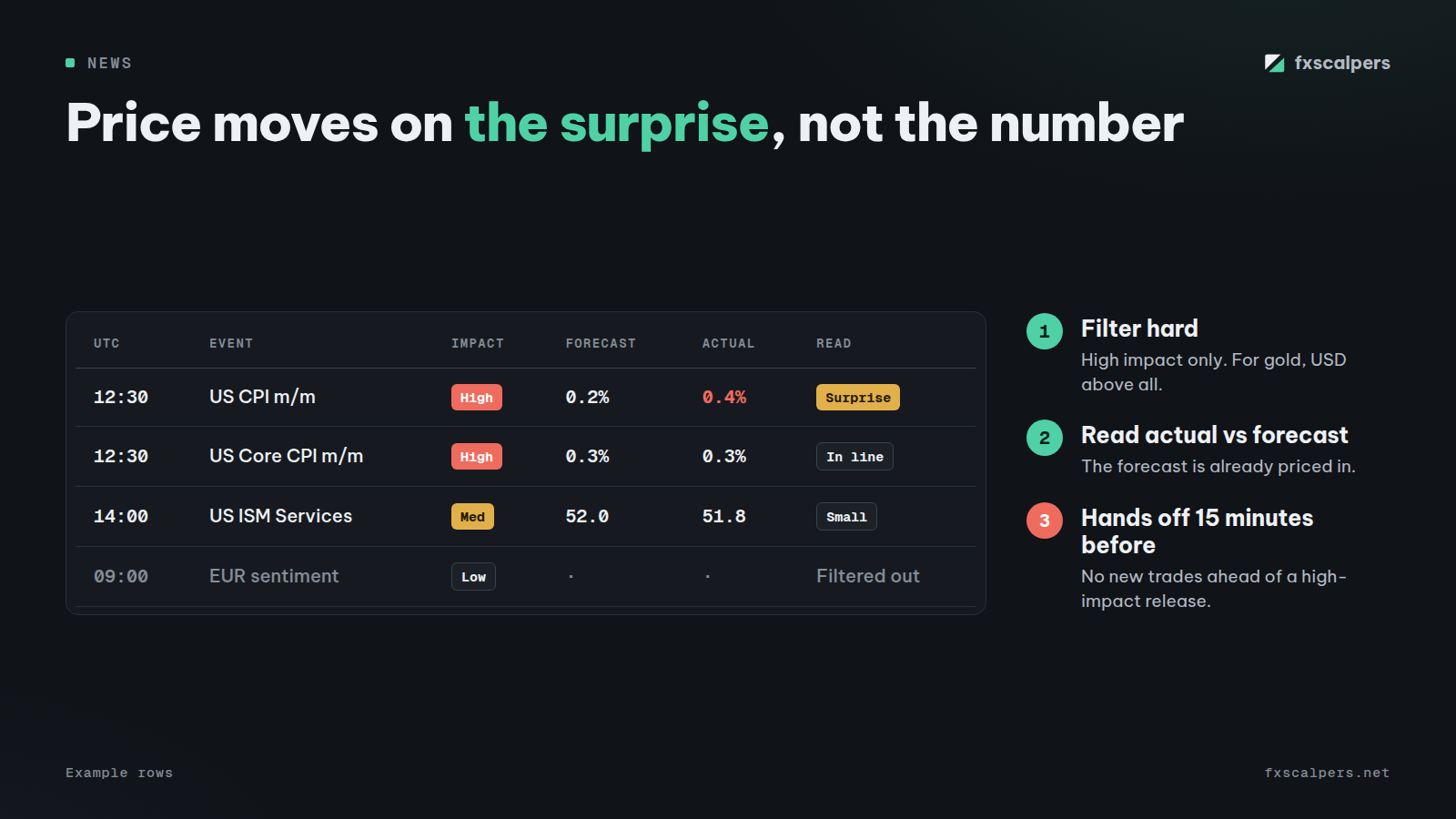
What moves price is the surprise: the gap between actual and forecast. A strong number that matches the forecast can produce almost nothing. A small miss on a closely watched number can produce a big move.
A worked example
US CPI m/m, forecast 0.2%, actual 0.4%. Hotter than expected by 0.2 points on a number the whole market watches. Expect a sharp move lower in gold as rate expectations rise, unless core CPI, released at the same time, came in at or below its forecast. In that case the first move can reverse within minutes. Illustrative numbers; the logic is the point.
Same day, 14:00 UTC, ISM Services forecast 52.0, actual 51.8. A small miss on a secondary number: a ripple, not a wave. And a EUR sentiment survey at 09:00 UTC rated low impact? Filtered out of the gold trader’s calendar entirely.
A scalper’s news rules
- No new trades in the 15 minutes before a high-impact release. Spreads widen before the number, and a setup that triggers just before the release is a news bet in disguise.
- Decide in advance what happens to open trades: close, or hold with a stop you accept may be slipped. Never decide in the last 30 seconds.
- Hands off until spreads are back to normal. Usually a few minutes on the majors, sometimes longer on gold. Check the spread before you click, not after.
- Size for slippage on news days. A stop can fill worse than its price in a fast market. Size as if it were wider. The lot size calculator helps.
Building a weekly news map
On Sunday, write a short list: day, time in UTC, event, currency. Mark the two or three biggest events of the week. Then decide for each one: stay flat, trade after the dust settles, or trade a dedicated news setup like the news spike fade. A five-line list done in five minutes removes most of the week’s nasty surprises.
Quick FAQ
Which calendar should I use?
Any major free calendar works. What matters is the time zone setting and the impact filter, not the brand.
Do I need to understand economics?
No. You need the time, the impact and the surprise. The chain behind CPI helps, but the rules above work without a degree.
What about unscheduled news?
Geopolitical headlines hit without warning. That’s why every position has a stop and why size stays sensible even on quiet days.
Traps to avoid
- Trading “low impact” releases as if they were nothing: in a nervous market even secondary data can spike gold.
- Forgetting daylight saving when the calendar is in local time.
- Tight stops held through a release. The spread alone can take them.
The Free channel sends high-impact alerts before the big releases: the exact time, what spreads usually do, and what to do with open trades. Join and let the calendar come to you.