XAUUSD pip value explained: what $1 on gold is really worth
Nobody agrees on what a gold pip is. Think in dollars per ounce instead: 1 lot is 100 ounces, and the math gets simple.
“How much is a pip on gold?” is one of the most searched questions in trading, and one of the most confusing, because brokers and traders don’t even agree on what a gold pip is. The good news: you don’t need pips at all. Think in dollars per ounce and every gold calculation becomes one line of arithmetic.
The short version
- 1 standard lot of XAUUSD is 100 ounces.
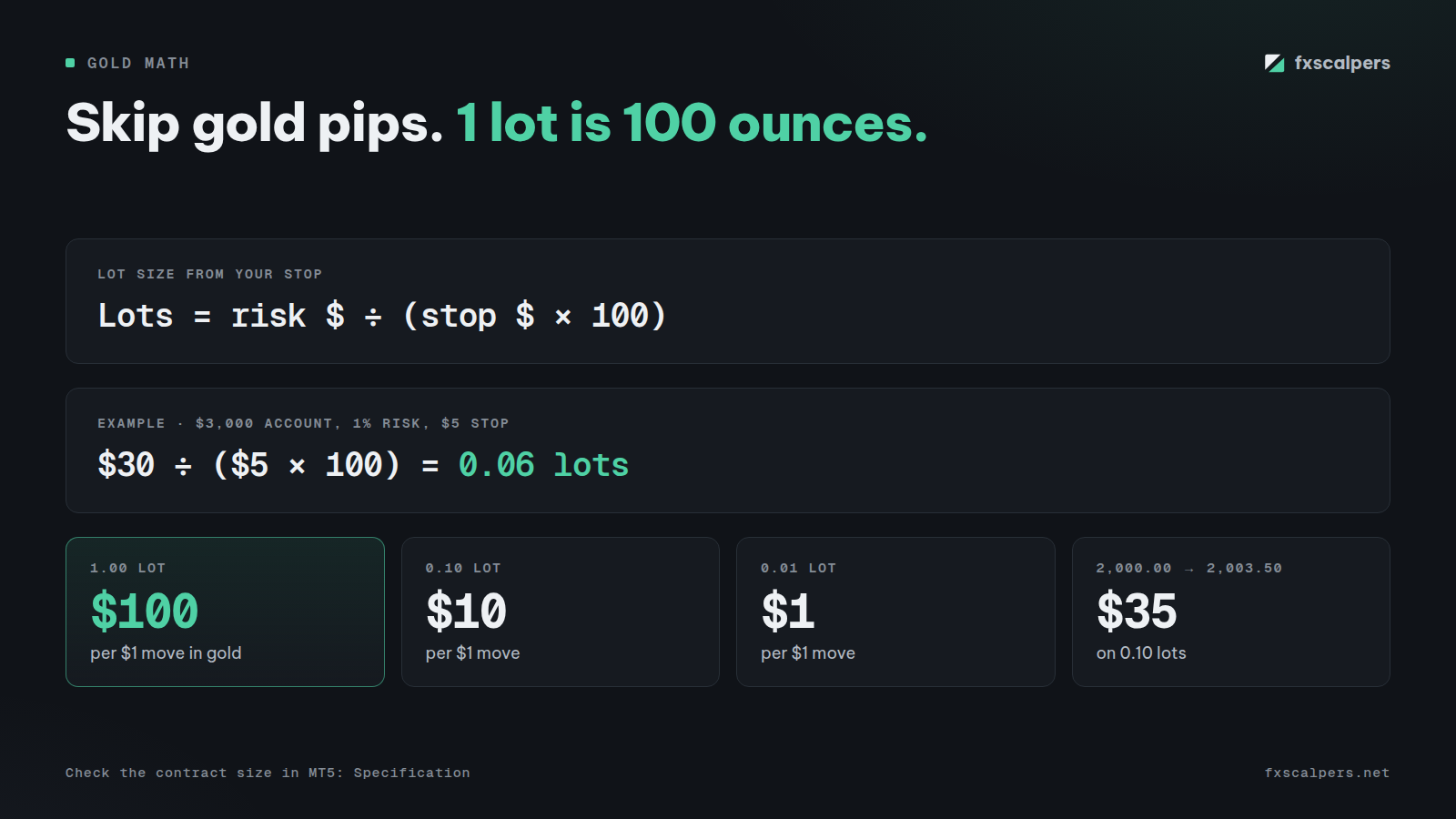
- So every $1 move in the gold price is worth $100 per lot, $10 per 0.10 lot and $1 per 0.01 lot.
- Lot size = risk in dollars ÷ (stop distance in dollars × 100).
- Confirm the contract size in your platform before trusting any of it.
The only number you need
1 standard lot of XAUUSD is 100 ounces. So every $1 move in the gold price is worth:
- 1.00 lot: $100
- 0.10 lot: $10
- 0.01 lot: $1
If gold moves from 2,000.00 to 2,003.50, that’s a $3.50 move. On 0.10 lots, that’s $35. On 1 lot, $350. On 0.01 lots, $3.50. That’s the entire system. No tables, no conversion, no pip definitions.
Why “pips” on gold confuse everyone
On EUR/USD a pip is universally the fourth decimal place, worth $10 per standard lot. Gold has no such convention. Some platforms and traders call $0.10 a pip, others call $0.01 a point, and others call $1 a pip. That’s how two traders can describe the same trade in wildly different numbers:
- “I made 50 pips on gold” could mean $5 of movement if a pip is $0.10.
- It could mean $0.50 if someone counts $0.01 points as pips.
- It could mean $50 if they count whole dollars.
That ambiguity is exactly why signal groups love quoting gold results in pips: the number sounds huge and can’t be checked. Every FXScalpers gold setup is written in price levels and dollar distances, never in gold pips. You always know exactly what the stop and the target mean for your account.
From stop distance to lot size
The formula:
Lots = risk in dollars ÷ (stop distance in dollars × 100)
Worked through three accounts:
- $1,000 account, 1% risk ($10), $3 stop: $10 ÷ ($3 × 100) = 0.033, round down to 0.03 lots.
- $3,000 account, 1% risk ($30), $5 stop: $30 ÷ ($5 × 100) = 0.06 lots.
- $10,000 account, 0.5% risk ($50), $8 stop: $50 ÷ ($8 × 100) = 0.0625, round down to 0.06 lots.
Always round down. Rounding up by one step on a small account can add a meaningful slice of extra risk. Or use the lot size calculator: pick XAUUSD, enter your balance, risk and stop in dollars, and it rounds down for you.
From lot size back to money
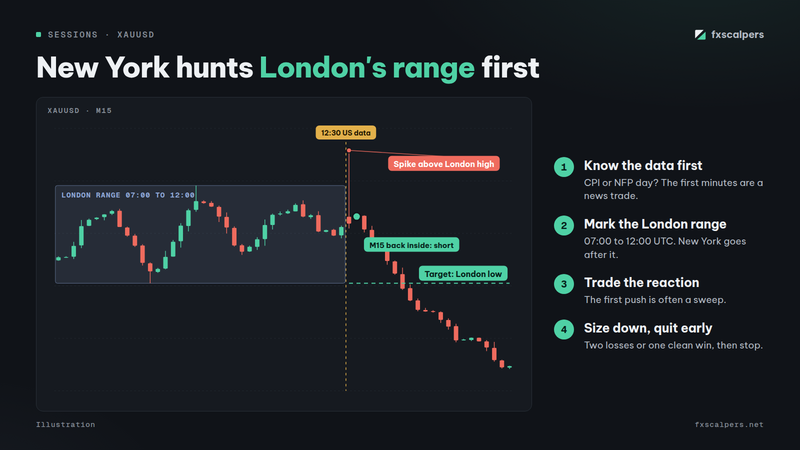
The same number works the other way. Holding 0.20 lots and gold moves $6 against you? 0.20 × 100 × $6 = $120. Target is $9 away? 0.20 × 100 × $9 = $180. You can check any position in your head in two seconds, which is exactly what you want when gold is moving fast at the New York open.
Spread and commission in the same units
Gold costs are quoted the same way. A spread of 0.25 means $0.25 per ounce, which is $25 per lot, paid the moment you enter. A $7 commission per lot on a Raw account comes on top. So a 0.10 lot scalp pays about $2.50 in spread plus $0.70 commission before price moves at all. On small targets that cost matters. Raw vs Standard runs the full comparison.
Watch the contract size
A few brokers use a different contract size for gold, or offer “micro” gold symbols such as XAUUSDm or GOLD.micro with 1 or 10 ounces per lot. If the contract is 10 ounces, every number above is ten times smaller per lot, and a lot size calculated for 100 ounces would risk ten times less than planned. If it’s 100 ounces and you assumed 10, you’d risk ten times more.
Check before your first trade: in MT5, right-click the symbol in Market Watch, open Specification and read the contract size. If it says 100, everything in this article applies exactly.
Traps to avoid
- Copying lot sizes from someone else. “I trade 0.50 on gold” means nothing without their balance and stop. Size from your own numbers.
- Keeping the same lot when the stop widens. A $3 stop and a $9 stop need very different sizes for the same risk. The stop decides, the lot follows.
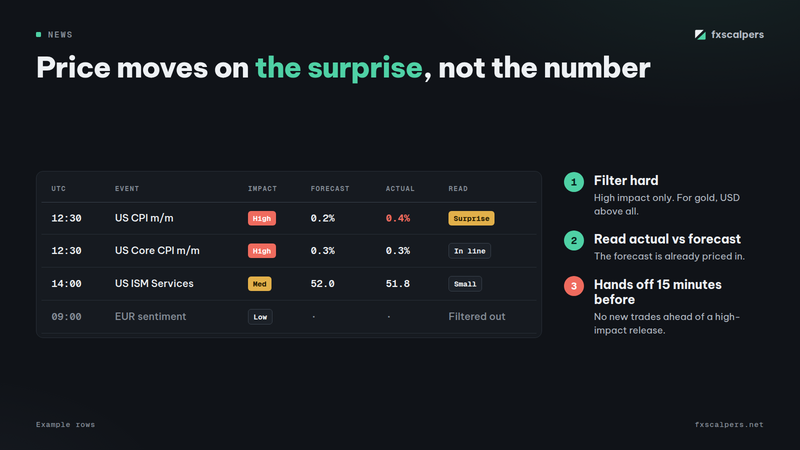
- Forgetting slippage around news. A $4 stop can fill $2 worse during CPI or NFP. On news days, size as if the stop were wider. See reading the economic calendar.
- Mixing account currencies. If your account is in EUR or another currency, the dollar result is converted at the current rate. The calculator handles it; mental math needs a small adjustment.
Why this matters more on gold than anywhere else
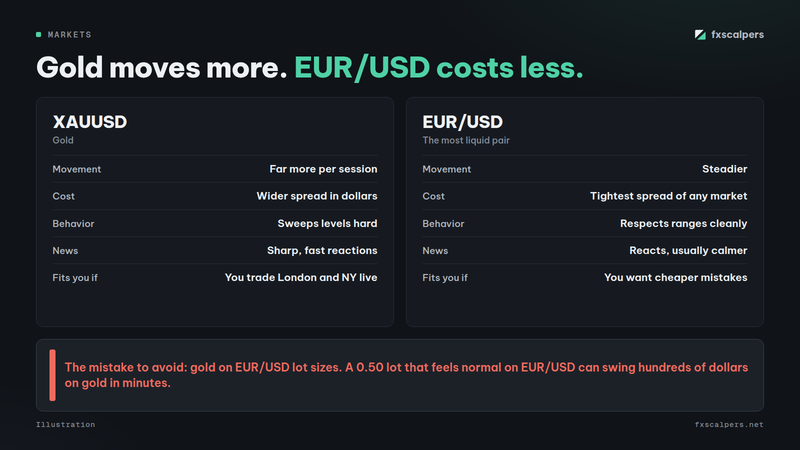
Gold moves more per session than the major pairs, so a sizing mistake that would cost a little on EUR/USD can cost a lot on XAUUSD. Traders who switch from forex to gold without switching their math are the ones who get hurt in their first week. Gold vs EUR/USD walks through the same risk on both markets side by side.
Quick FAQ
So what is a gold pip, really?
There’s no universal answer, which is why it’s better not to use it. Think in dollars of price movement and multiply by 100 per lot.
Does leverage change these numbers?
No. Leverage changes margin, not the value of a $1 move. Leverage isn’t what blows accounts.
Every gold setup in the Free channel comes with the entry, the stop and the target as prices, so the dollar distance is right there for the formula above. Join, take the next setup’s stop distance, and size it yourself before price gets there.