Leverage isn’t what blows accounts. Position size is.
The same trade at 1:500 and 1:50 risks exactly the same money. What actually changes, and the sizing formula every trade should start with.
“1:500 leverage is gambling.” You’ll hear it in every forex forum. It sounds wise, and it misses the point. Leverage doesn’t decide how much you lose on a trade. Position size and stop distance do. Leverage only decides how big a position your broker will let you open.
The short version
- Leverage caps how big a position you can open. Lot size and stop distance decide how much you lose.
- The same trade at 1:500 and 1:50 risks exactly the same money.
- Accounts blow up at high leverage because it allows oversizing. Size from risk, never from free margin.
The same trade at two leverages
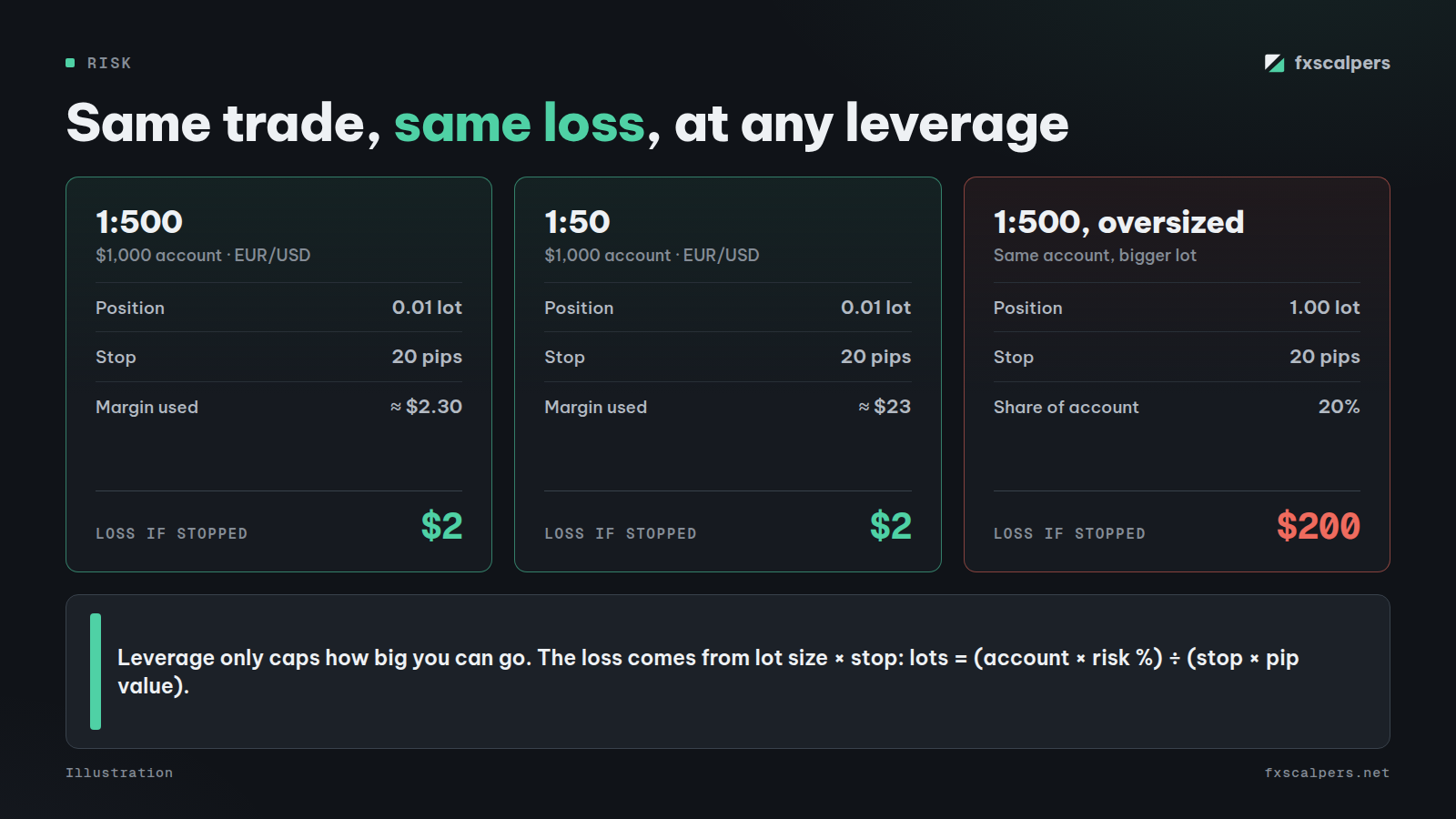
A $1,000 account buys 0.01 lots of EUR/USD with a 20 pip stop.
- At 1:500, margin used is about $2.30. If the stop hits, the loss is $2.
- At 1:50, margin used is about $23. If the stop hits, the loss is still $2.
Identical risk. The only difference is how much free margin sits unused in the account.
So why do high-leverage accounts blow up?
Because high leverage allows oversizing. At 1:500, that $1,000 account can open well over a full lot of EUR/USD. With a 20 pip stop on 1 lot, one loss is $200, a fifth of the account. Three of those and the account is gone. The leverage didn’t cause it. The lot size did.
Size every trade from risk, not from margin
The formula every trade should start with:
Lots = (account × risk %) ÷ (stop in pips × pip value per lot)
- EUR/USD: a $2,000 account risking 1% is $20. A 25 pip stop at $10 per pip per lot: $20 ÷ $250 = 0.08 lots.
- Gold: risk in dollars ÷ (stop in dollars × 100 ounces per lot). $20 ÷ ($4 × 100) = 0.05 lots.
Do this before every trade and your maximum loss is fixed before you click, whatever your leverage is. Or let the FXScalpers lot size calculator do it in two seconds.
When leverage does matter
- Stop out. Too little margin and a spike can close positions before your stop is reached. Keep margin level comfortably high.
- Stacking positions. Five trades at 1% each is 5% at risk, and high leverage makes that easy to do without noticing.
- Gaps. Over a weekend gap, your stop can fill far from where it was placed. Size overnight trades smaller.
What margin actually is
Margin is the deposit the broker locks while a position is open. Required margin = position value ÷ leverage. One standard lot of EUR/USD near 1.15 is worth about $115,000; at 1:500 it needs about $230 of margin, at 1:50 about $2,300. Margin is not a cost and not a loss. It comes back when you close. What you can lose is decided by how far price moves against the position, which is the stop distance times the lot size.
A worked example: three traders, one account size
Three traders each have $2,000 and take the same EUR/USD setup with a 20 pip stop.
- Trader A, 1:500, sized from 1% risk: $20 ÷ (20 × $10) = 0.10 lots. Loss if stopped: $20.
- Trader B, 1:30, sized from 1% risk: same 0.10 lots, just more margin locked. Loss if stopped: $20.
- Trader C, 1:500, sized from “what the margin allows”: 2 lots because the platform accepted it. Loss if stopped: $400, a fifth of the account.
A and B are the same trader in different clothes. C has a sizing problem that happens to be enabled by leverage. Take leverage away and C would still find a way to risk too much; give A 1:1000 and nothing changes.
Pre-trade checklist
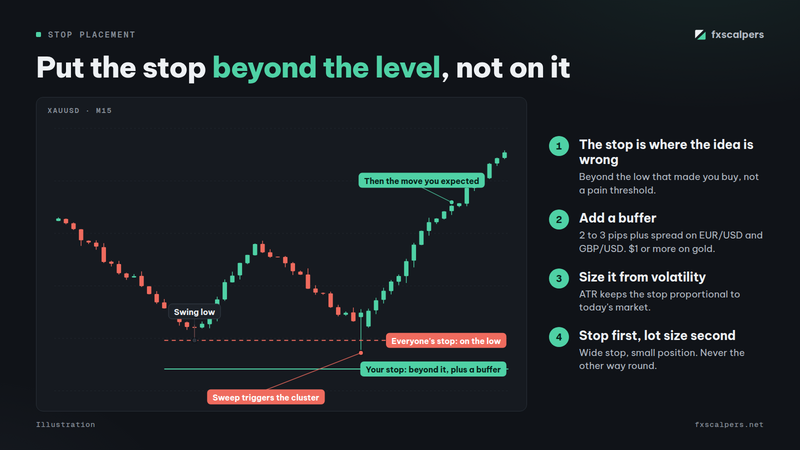
- Where is the stop, based on structure? Beyond the level, not on it.
- What’s my risk in dollars: balance × risk %?
- Lots = risk ÷ (stop × value per pip or per dollar), rounded down.
- Total open risk across all positions still within my daily limit?
- Margin level comfortably high after the trade?
Traps to avoid
Sizing by “how much margin is left”. If your lot size changes because free margin changed, you’re sizing to the broker’s limit, not to your risk. That’s the habit that turns high leverage into a blown account.
Quick FAQ
So is high leverage safe?
High leverage is a tool that makes oversizing easy. With disciplined sizing it’s harmless and frees up margin. Without it, any leverage is dangerous.
Should I lower my leverage anyway?
If you catch yourself sizing from free margin, a lower leverage setting is a useful guardrail. But the real fix is the formula.
What risk per trade is sensible?
Most scalpers risk 0.5% to 1% per trade. At 1%, ten losses in a row cost about 10%. At 5%, the same streak costs about 40%.
Every setup in the Free channel comes with a defined stop, so the formula above takes two seconds. Join and size the next one yourself.