Traders don’t lose from bad setups. They lose on what they do after the entry
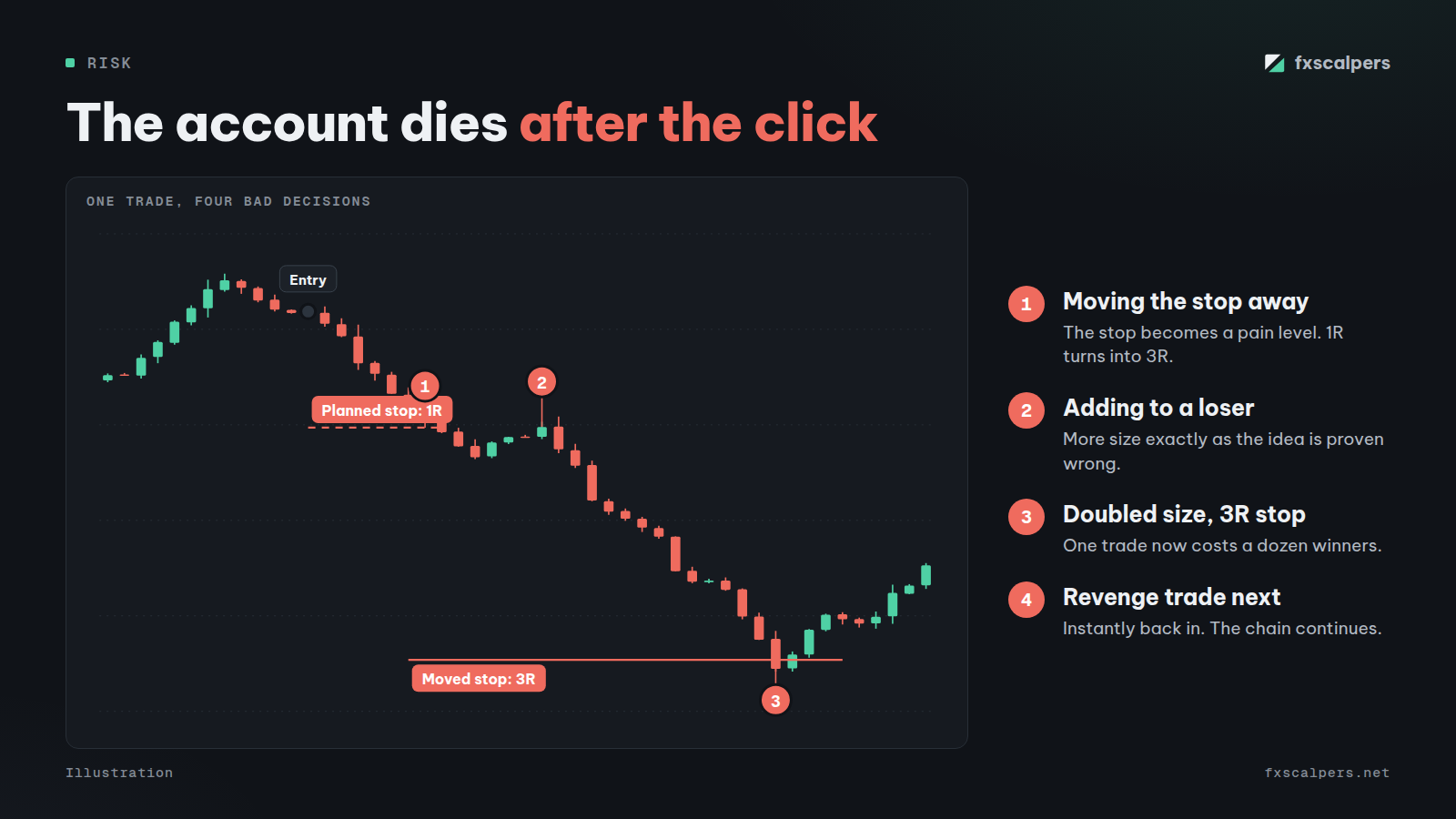
The first trade rarely blows an account. The four decisions that come after it do.
Ask a trader who just blew an account why it happened, and the answer is usually “bad setup”. Open the trade history and it’s a different story: the first trade was a small loss. What burned the account was the chain of decisions that came after, while price moved against them and their head stopped being clear.
The short version
- The first trade rarely blows an account. Four decisions after it do: moving the stop away, adding to a loser, cutting winners early, and revenge trading.
- Write four lines before every trade: the invalidation price, the risk %, the take-profit plan, and the stop rule for the day.
- Audit your last 50 trades: the ones you interfered with usually perform worse than the ones you left alone.
Four bad decisions after the entry
Moving the stop further away
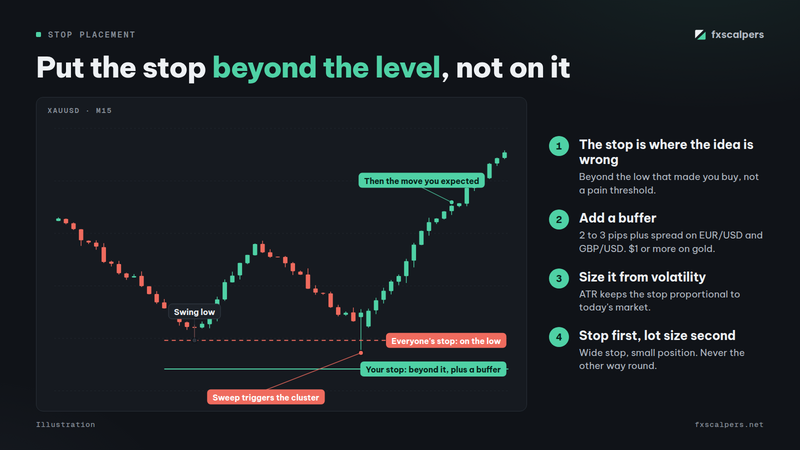
Price gets close to the stop, so the trader gives it “a little more room”. The stop is no longer the level that invalidates the idea. It’s now the level of pain tolerance. A 1R loss turns into a 3R loss. A few of those a month wipe out a dozen winning trades.
Adding to a loser
Adding more size in the same direction to improve the average price. It sounds logical, because “price only needs a small bounce to get back to breakeven”. In reality it’s increasing size at the exact moment the original idea is being proven wrong. Most one-day account blowups have a chain like this in them. The FXScalpers rule is simple: never add to a losing position.
Cutting winners early
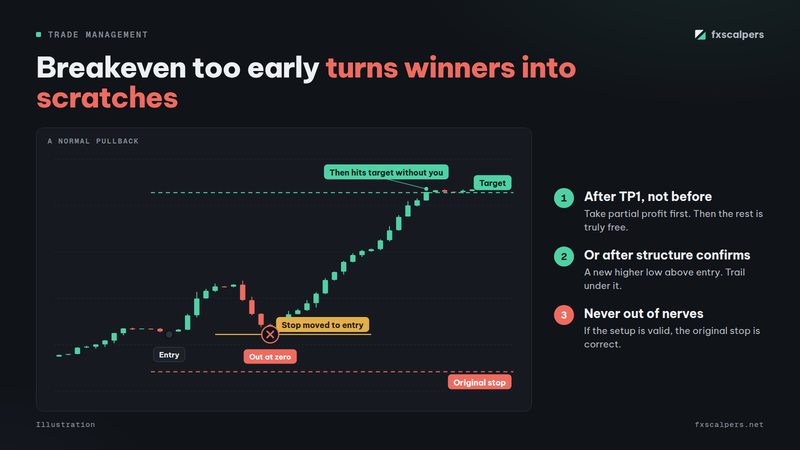
The mirror image of the losing trade: winners get closed the moment they show a little profit, out of fear of giving it back. The result is small wins and big losses. A 60% win rate can still blow the account. A close cousin is the breakeven stop trap.
Revenge trading
Just stopped out, the trader instantly opens the opposite direction, or the same direction with bigger size, to win it back. That trade has no analysis behind it. Only emotion.
What the chain looks like in numbers
A trader risks 1% on a gold buy with a $4 stop. Price drops $3.50. The stop gets moved to $8 away: the trade now risks 2%. Price keeps falling, so the trader adds the same size again “at a better price”: open risk is now around 4%. The stop at $8 is hit on both positions. One trade planned at −1% ends at roughly −4%. Then comes the revenge trade in the other direction, at double size, with no plan: another −2%.
Total: −6% in an afternoon from a setup that was supposed to cost 1% if wrong. Illustrative, but it’s the most common shape of a blown day, and none of it was caused by the entry.
Write the plan before you click
Every one of those decisions happens because, at entry, the trader never answered “what do I do if price goes against me”. Before every trade, write four lines:
- Which price proves the idea wrong. That’s the stop, and it never moves further away.
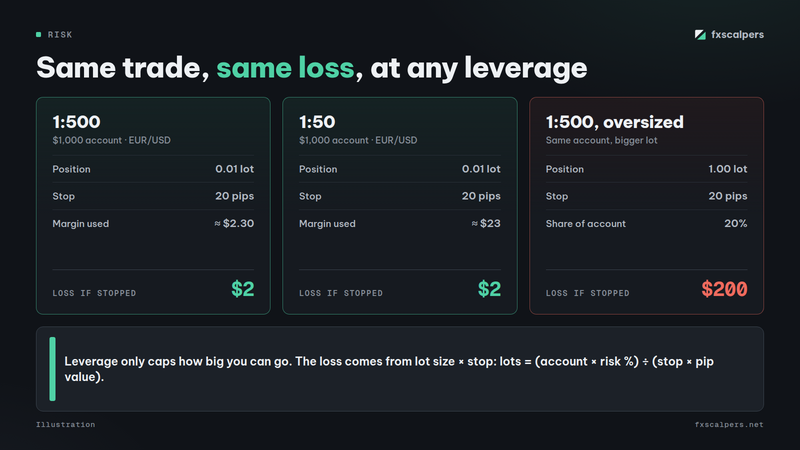
- Risk as a percentage of the account. No more than 1%.
- Where you take profit, and how much at each level.
- If this loses, how long you stop. Suggestion: two losses in a row ends the session.
If you can’t write those four lines in a minute, the setup isn’t clear. Don’t take it.
Audit your own history
Open your last 50 trades in MT5 (or better, keep a five-column journal). Mark every trade where you moved the stop, added to a loser, or closed before target without a reason. Add up the P&L of the trades you interfered with versus the trades you left alone. For most traders, the untouched group performs clearly better, and that’s the answer to “why do I keep losing”.
Quick FAQ
Isn’t averaging down a real strategy?
For planned scaling with a fixed total risk and a hard stop, it can be. Adding to a losing trade to avoid admitting it’s wrong is not a strategy; it’s hope with more lots.
How do I stop cutting winners early?
Take a partial at TP1 and let the rest run to a pre-set target or trailing rule. Having something banked makes it easier to leave the runner alone. The breakeven stop trap covers the other half of this problem.
What if I can’t stop revenge trading?
Take the decision away from the moment: a daily loss limit set in advance and the tilt checklist before every entry.
Every setup in the Free channel comes with the four lines already written: invalidation, stop, targets and follow-up. Join and practice trades where the plan exists before the click.