Where to put your stop loss so it stops getting hunted
Most stops get hit because they sit exactly where everyone else’s stop sits. Beyond the level, not on it, and sized from volatility.
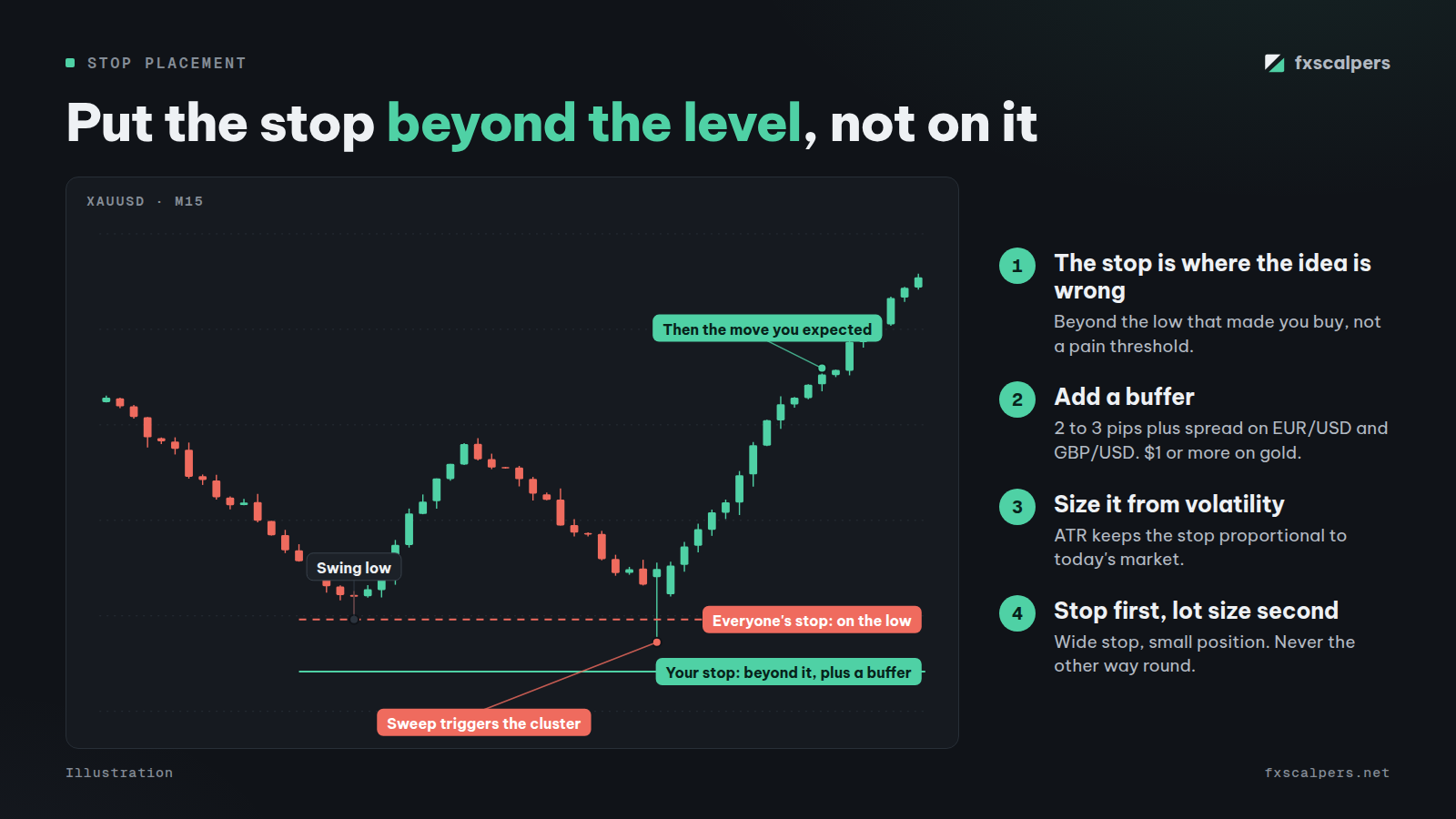
Most stops get hit for the same reason: they sit exactly where everyone else’s stop sits. Price sweeps that level, triggers the cluster, and then goes the way you expected, without you. Better stop placement is not about wider stops. It’s about smarter ones, placed where the market has to prove you wrong instead of where it can collect you on the way past.
The short version
- The stop goes where the trade idea is wrong, beyond the level that made you enter.
- Beyond the level plus a buffer, never exactly on it: 2 to 3 pips plus spread on the majors, $1 or more on gold.
- Size the buffer and the stop from volatility (ATR), not from a fixed number of pips.
- The stop comes first, the lot size second. Never tighten a stop to fit a bigger position.
The stop is where the idea is wrong
A stop isn’t a pain threshold and it isn’t a round number of pips. It’s the price that proves your trade idea wrong. If you bought because a low was holding, the stop belongs beyond that low. If price gets there, the reason for the trade no longer exists, and staying in is just hoping.
That gives you a simple test for any stop: if price hits it, is the setup invalid? If the answer is “not really, it could still work”, the stop is in the wrong place. Either it’s too tight (inside normal noise) or it isn’t tied to a level at all.
Beyond the obvious level, not on it
- Don’t place the stop exactly at the swing low. Place it beyond the low plus a buffer.
- For EUR/USD and GBP/USD, a 2 to 3 pip buffer beyond the level plus your typical spread is a good starting point.
- For gold, use a dollar buffer, often $1 or more, because sweeps on XAUUSD run deeper.
- Avoid round numbers for the stop itself. Round numbers are liquidity magnets.
Why the buffer matters: the swing low is the most obvious level on the chart, so it’s where the stops of every trader who took the same idea sit. That cluster is liquidity, and price is drawn to it. Sweeps of the obvious low by a few pips, or a dollar or two on gold, happen constantly before the real move. Sweep or breakout explains the mechanics.
A worked example
Gold sells off to a swing low at 2,000.00, bounces to 2,011, and pulls back. You buy at 2,004.20 on a higher low forming above 2,000.
- The crowd’s stop: 1,999.90, right under the low. Risk $4.30.
- Your stop: beyond the low plus a buffer sized to the day: 1,996.80. Risk $7.40.
An hour later gold spikes to 1,998.60, taking every stop under 2,000, then closes back above it and rallies to 2,021. The crowd was stopped out for −1R. You risked more per ounce, so you held a smaller position, and the trade made more than 2R. Illustrative prices; the pattern repeats every week.
Use volatility, not a fixed number
A 15 pip stop is huge on a quiet Asian morning and tiny during NFP. A fixed stop ignores the market you’re actually trading. Sizing stops with ATR keeps them proportional: a common approach is a buffer of about half an ATR beyond the level, or a total stop of 1 to 1.5 ATR on the entry timeframe. See the ATR approach on gold for a worked example.
Then size the position from the stop
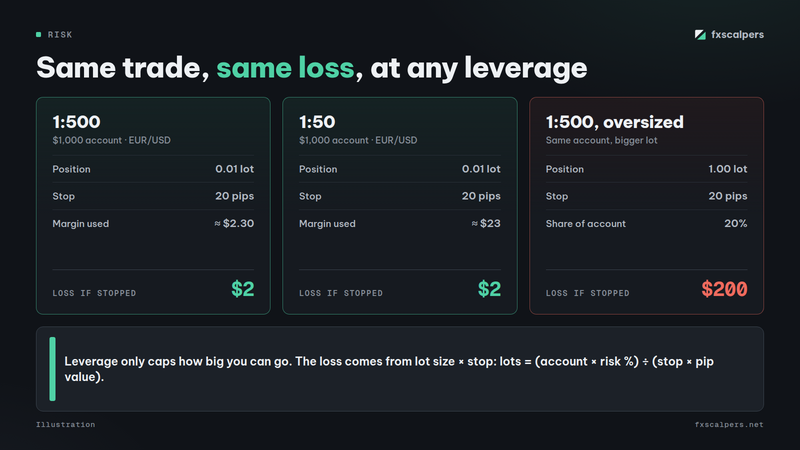
The stop comes first. The lot size comes second. If the correct stop is wide, the position is small. Never tighten a stop just to fit a bigger position. That’s choosing a stop the market will hit so you can feel a bigger trade.
In the example above, on a $3,000 account risking 1% ($30): the crowd’s $4.30 stop allows 0.06 lots; your $7.40 stop allows 0.04 lots. Same $30 at risk either way. The only difference is which stop survives the sweep. The lot size calculator does the sizing in two seconds.
Stops by setup type
- Retest of a broken level: beyond the retest low (or high), plus the buffer.
- Sweep entry: beyond the sweep extreme, plus the buffer. The sweep is the invalidation.
- Order block: beyond the far edge of the zone. Order block rules.
- Trend pullback: beyond the pullback low that forms the new higher low.
Pre-trade checklist
- Which level proves the idea wrong?
- Is the stop beyond it, with a buffer, and not on a round number?
- Is the buffer sized to today’s volatility?
- Is any news or the rollover inside the trade’s likely lifetime?
- Lot size calculated from this stop, rounded down?
Traps to avoid
- Stops inside the spread widening zone around rollover or news. A stop 3 pips away can be hit by a spread that widens to 4. If you hold through those windows, the stop needs to account for them. Spreads at rollover.
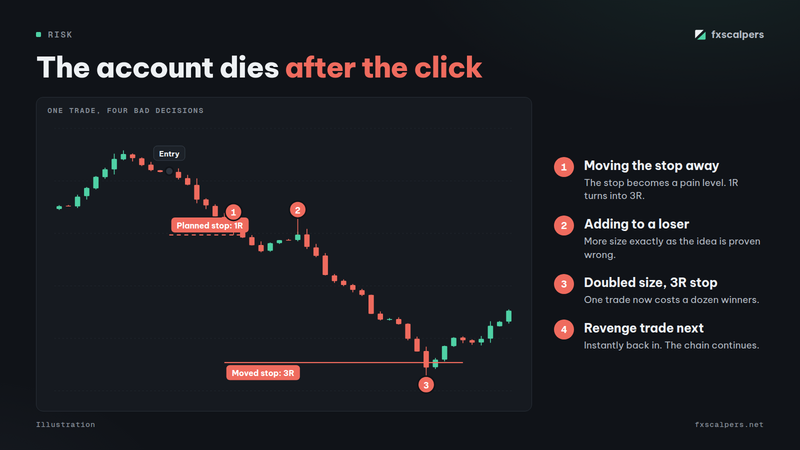
- Moving the stop further away once the trade is running. The first stop was the plan. What you do after the entry decides most blown accounts.
- Mental stops. A stop that isn’t in the platform doesn’t exist when gold moves $10 in a minute.
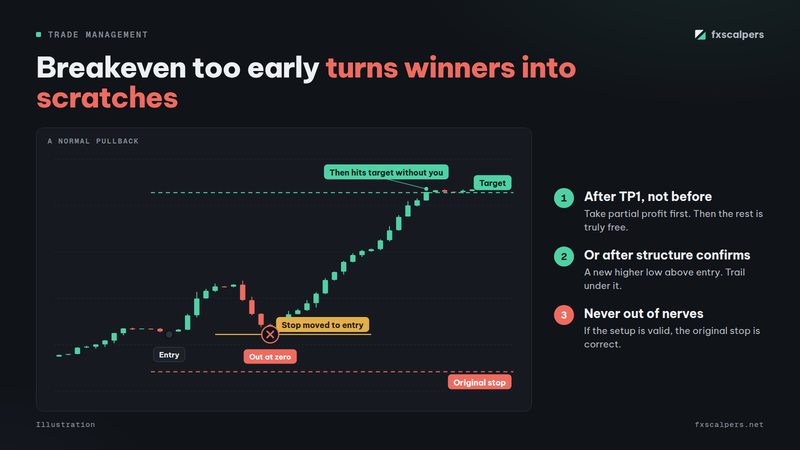
- Breakeven too early. Moving the stop to entry at the first twitch turns winners into scratches. The breakeven trap.
Quick FAQ
Isn’t a wider stop more risk?
Not if you size from it. Risk is dollars, not distance. A wider stop with a smaller position risks the same money and survives more noise.
What if the correct stop makes the target less than 1.5R?
Then the setup doesn’t pay enough. Skip it. That’s a filter, not a problem.
Every setup in the Free channel is posted with the stop already placed beyond the level, with a buffer, before price gets there. Join and compare where your stops would have been.