Scalping Order Blocks on USD/CHF: only when the zone is clean
A strict definition: it must break structure, leave an imbalance, and be untouched. And only in the direction of H4.
“Order block” gets thrown around so much it has lost its meaning. Online, almost any candle before a move gets called an OB. This article uses a strict definition, because the looser the definition, the easier it is to talk yourself into a trade.
The short version
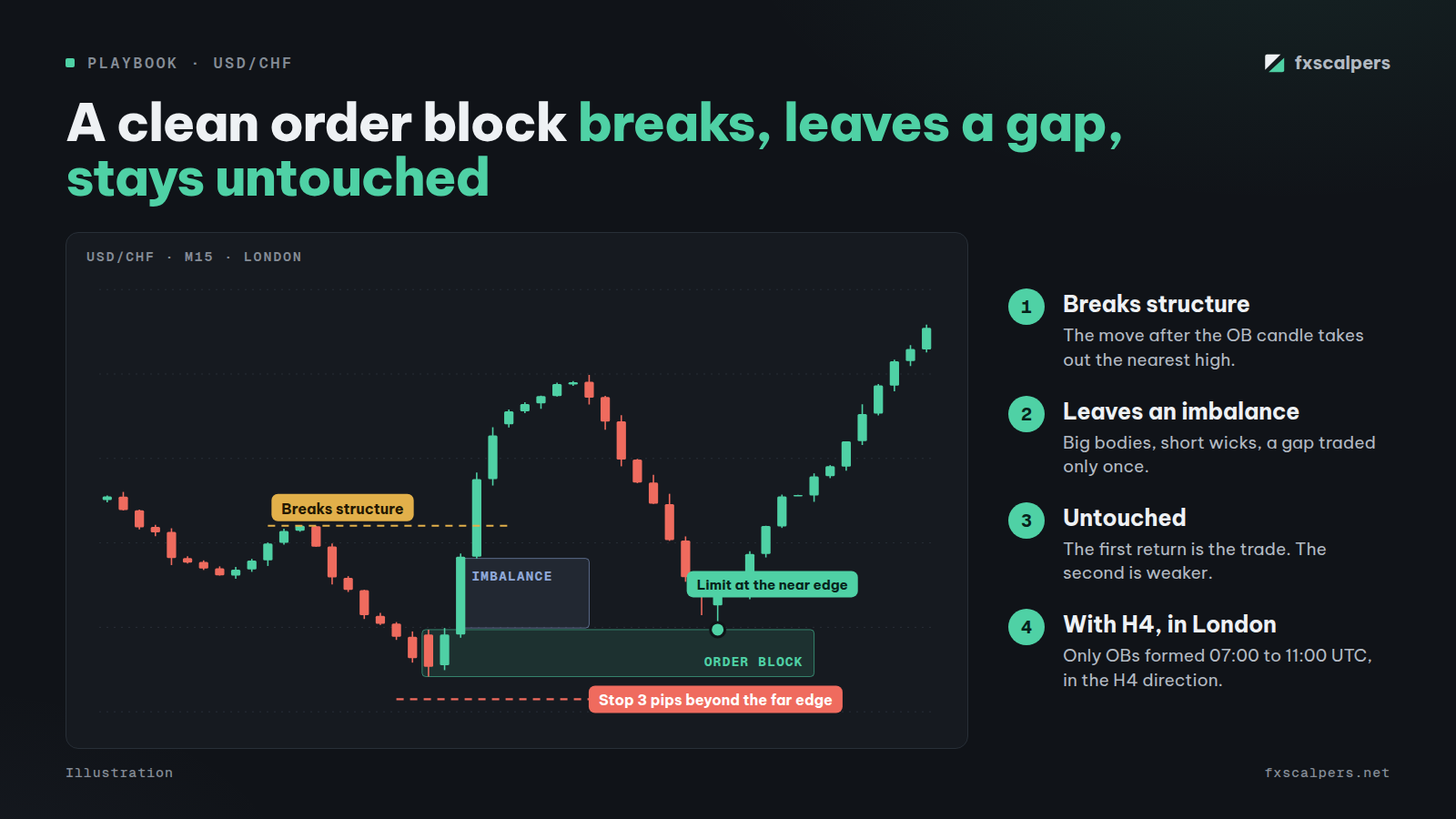
- A tradeable order block needs all three: the move after it breaks structure, it leaves an imbalance, and the zone is untouched.
- USD/CHF M15, only OBs formed 07:00 to 11:00 UTC, only in the H4 direction.
- Limit at the near edge, stop 3 pips beyond the far edge, target the high or low the move broke, minimum 1.5R.
A tradeable order block needs all three
- A move that breaks structure. After the OB candle, price must break the nearest high (for a bullish OB) or low (for a bearish OB) on the same timeframe. A move that breaks nothing leaves you with an ordinary candle.
- An imbalance left behind. The move runs fast enough to leave a price gap traded only once: big bodies, short wicks, nothing filling it back in. That imbalance is the footprint of large one-sided orders.
- Untouched. Once an OB has been tested, most of the orders parked there are filled. The second test is much weaker.
The OB zone runs from the low to the high of the last opposite candle before the move, wicks included.
Why USD/CHF, and why London
USD/CHF moves slower than GBP/USD with fewer violent sweeps, so M15 order blocks get respected more cleanly. Only trade OBs formed between 07:00 and 11:00 UTC, when Europe brings liquidity. OBs formed in Asia are usually candles from a thin market, with no big-order footprint at all.
Entry rules
Place a limit order at the near edge of the OB, not the middle. Stop 3 pips beyond the far edge. On USD/CHF M15, a tradeable OB is usually 8 to 15 pips thick. Anything over 20 pips makes the stop too wide for the target. Skip it.
Target the high or low the move broke. If that’s less than 1.5R, don’t place the order.
Cancel the order when
- Price rushes back into the zone with 2 or 3 big candles in a row. That speed means the other side is strong and the zone is unlikely to hold.
- 24 hours pass without price returning. The context has changed.
- Major CHF or US data is due before price reaches the zone.
A worked example
H4 on USD/CHF is bullish. At 08:15 UTC the last bearish M15 candle before a rally spans 0.8812 to 0.8823. The rally that follows breaks the previous M15 high at 0.8841 in three big-bodied candles, leaving a gap between the first candle’s high and the third candle’s low that nothing fills.
- Zone: 0.8812 to 0.8823, 11 pips thick, inside the 8 to 15 pip band.
- Entry: buy limit at the near edge, 0.8823.
- Stop: far edge 0.8812 minus 3 pips = 0.8809. Risk: 14 pips.
- Target: the broken high at 0.8841 area and beyond, for example 0.8848. Reward: 25 pips, about 1.8R. Above the 1.5R minimum, so the order goes in.
Two hours later price drifts back into the zone with small candles, fills the limit at 0.8823, and the trade works. If instead it had rushed back with three big red candles, the order would have been cancelled before the fill. Illustrative prices.
Pre-order checklist
- Did the move after the OB candle break the nearest high or low? (Structure)
- Is there an imbalance left behind? (Footprint)
- Has price returned to the zone yet? (Must be untouched)
- Formed between 07:00 and 11:00 UTC, in the H4 direction?
- Zone 8 to 15 pips thick, target at least 1.5R?
- No CHF or US data before price is likely to reach the zone?
Traps to avoid
Order blocks against the higher timeframe. A bullish M15 OB while H4 is falling gets run over constantly, because H4 orders outweigh M15 orders. Only trade OBs in the direction of H4 structure.
Drill it before you trade real money
Mark 30 OBs that meet all three criteria on USD/CHF M15 over two months. Split them into OBs with the H4 trend and OBs against it. Those two result columns are usually enough to make you never trade a counter-trend OB again.
Quick FAQ
Why the near edge and not the middle?
The best zones often get only a light touch. An order in the middle misses them, and a deep push to the middle is itself a warning sign.
Does this work on gold?
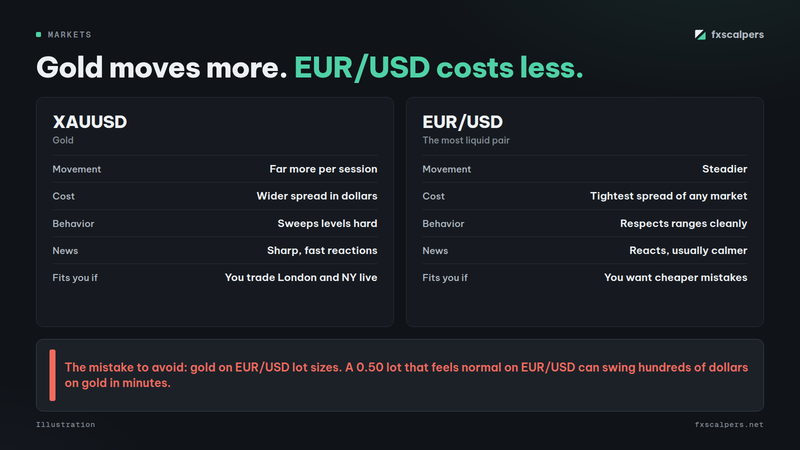
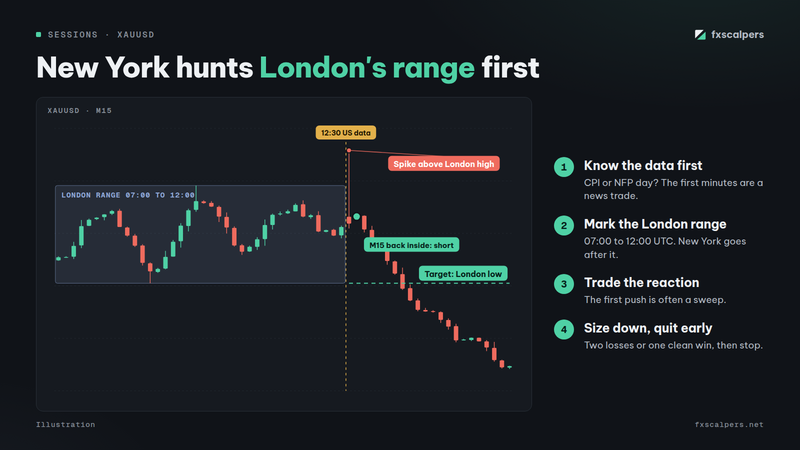
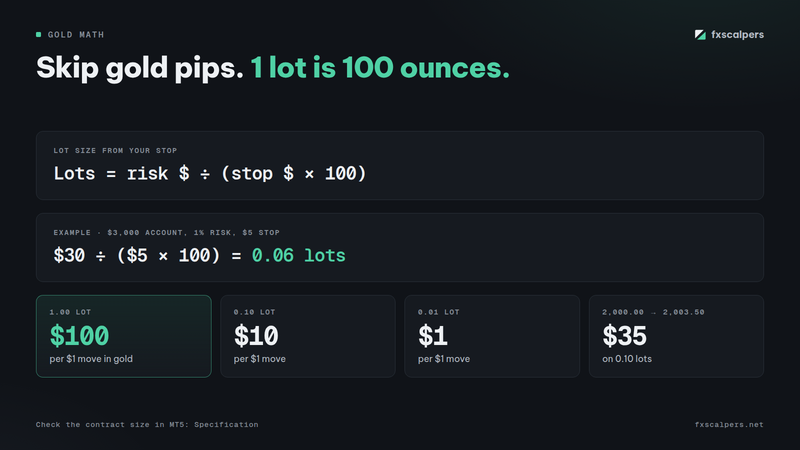
The three criteria apply everywhere, but gold zones are wider and sweeps deeper. Size stops in dollars and use ATR to judge thickness.
Order block setups in the Free channel are posted as limit orders at the zone with the stop and target attached, before price returns. Join and see which zones hold.