Scalping gold at the New York open: five rules
The best window of the day for XAUUSD, if you respect how fast it moves. The timeline in UTC and five rules for the open.
The New York open is where gold earns its reputation. Volume jumps, US data lands, and XAUUSD can cover more ground in an hour than it did all morning. It’s the best window of the day for scalping gold, if you respect how fast it moves. Treat it like any other hour and it will take your stop, your confidence and your afternoon in one candle.
The short version
- The window runs from about 12:00 UTC (New York arrives) to 16:00 UTC (London closes), shifted one hour in winter.
- Know the data before the session, mark the London range, trade the reaction instead of the first push, size down, and quit early.
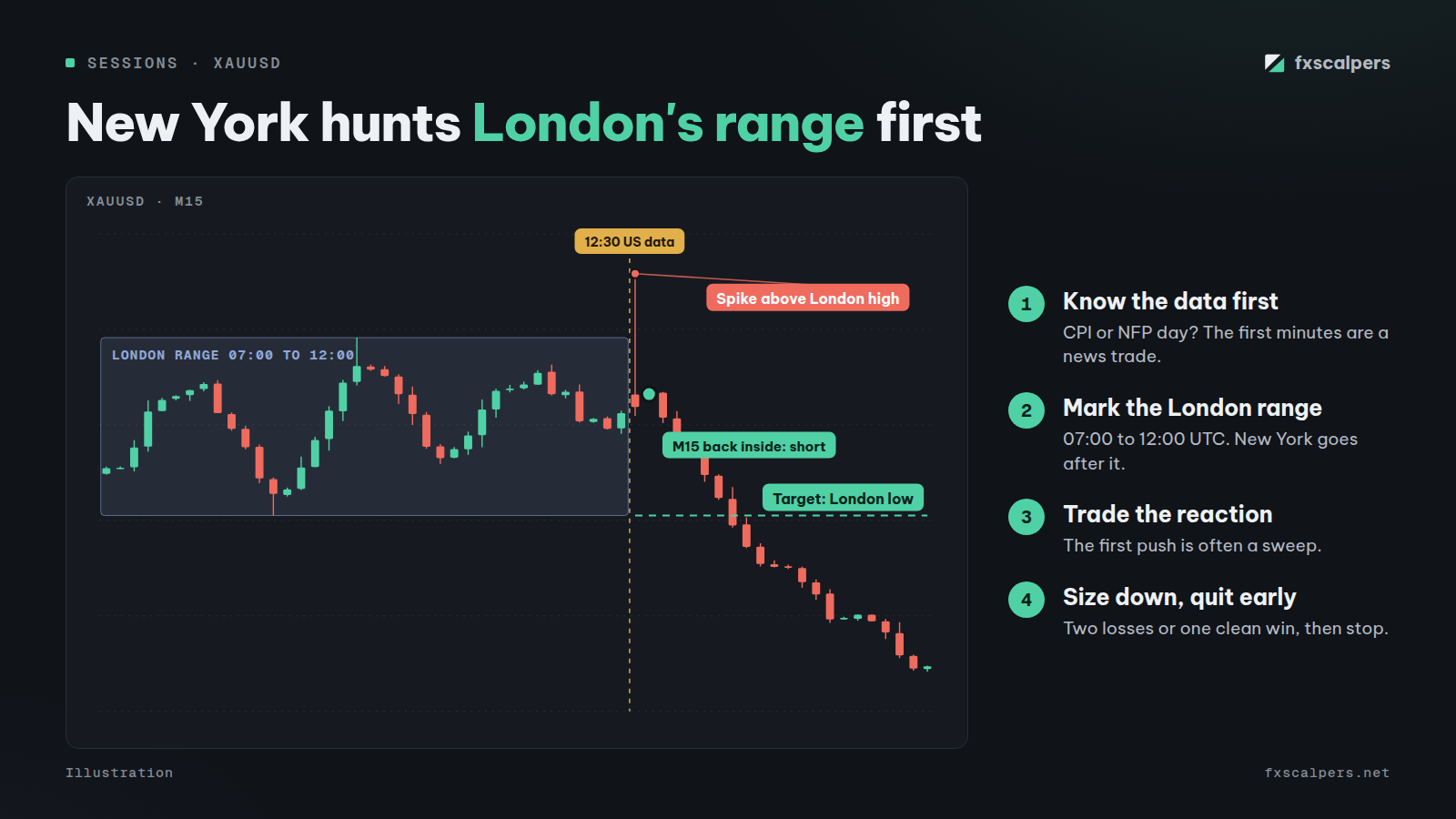
- The classic setup: New York sweeps one side of the London range, an M15 candle closes back inside, and the trade targets the other side.
The timeline
- 12:00 to 12:30 UTC (summer): New York traders arrive while London is still open. Volume builds.
- 12:30 UTC: most major US data drops (13:30 in winter): CPI, NFP, retail sales, jobless claims. Spreads spike for a few minutes.
- 13:30 to 14:00 UTC: US equity markets open, often adding a second wave of volatility. Some data, such as ISM, lands at 14:00.
- 15:30 to 16:00 UTC: London closes and gold’s pace usually cools.
Times shift when clocks change; the session clock shows the exact hours in your own time zone.
Five rules for the open
1. Know the data before the session
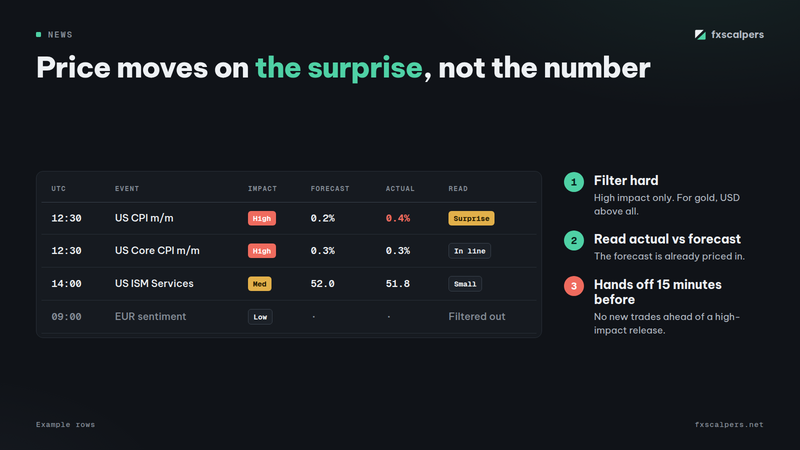
If CPI or NFP is out, the first minutes are a news trade, not a technical one. Levels get blown through, spreads widen five to ten times, and fills slip. Either trade a dedicated news setup such as the news spike fade or wait 15 minutes. Why gold spikes on CPI explains the mechanics.
2. Mark the London range
The high and low printed between 07:00 and 12:00 UTC are the first liquidity New York goes after. Stops of London traders sit just beyond them. Draw both lines before 12:00.
3. Let the first move reveal itself
The first push of the New York session is often a sweep of the London range, not the start of the real move. Trade the reaction, not the push. That means waiting for the M15 candle to close.
4. Size down
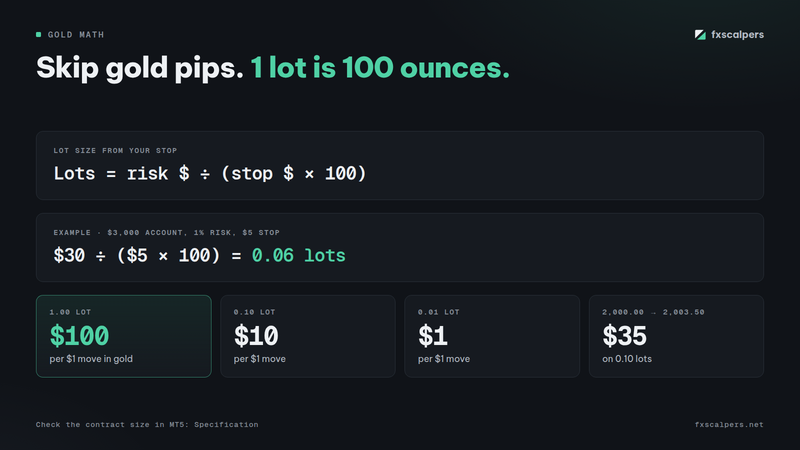
Stops need more room at the open. Keep the same dollar risk with smaller lots. If your normal gold stop is $3, the open may need $5; the lot size calculator turns that into the right size in seconds.
5. Quit while the window is open
Two losses or one clean win, then stop. The open rewards patience, not volume. Most blown New York sessions start with a good first trade followed by four impulsive ones.
A clean example of the logic
London builds a range between 2,330 and 2,340. At 12:30 UTC, gold spikes to 2,343.60, clearing the London high and every stop above it. Then the M15 candle closes back inside the range at 2,336.
That close is the tell. The breakout buyers are trapped above 2,340, and the spike filled the sell orders that were waiting there. The short setup:
- Entry: on the M15 close back inside, or a retest of 2,339 to 2,340 from below.
- Stop: above the spike high, 2,344.40 (spike plus a buffer).
- Target: the London low at 2,330.
Risk about $8, reward about $6 to $9 depending on the fill. If the fill is poor, the trade doesn’t make sense and you pass. If instead the M15 candle closes above 2,340 with a full body and the next candle holds, it’s a real breakout, not a sweep, and the short is off. Sweep or breakout goes deeper on telling them apart.
Days that behave differently
- CPI and NFP days: the first 15 minutes are a different market. Plan for it or skip it.
- FOMC days: the big move often comes at 18:00 or 19:00 UTC, after the normal window. The morning can be dead as traders wait.
- US holidays: no real New York session. Don’t force the setup.
- Fridays: strong mornings, erratic afternoons as the week closes.
Pre-session checklist
- Calendar checked, exact data time noted in UTC.
- London high and low drawn, plus yesterday’s high and low.
- Weekly plan bias known: are we looking for longs, shorts, or both?
- Lot size calculated for a wider open stop.
- Daily stop rule written: two losses or one clean win.
Quick FAQ
Should I enter the moment the London high breaks?
No. That’s exactly when sweeps happen. Wait for the M15 close; it filters out most traps.
What if nothing happens by 14:00 UTC?
Then nothing happens. Some days the overlap is quiet. A flat session is better than a forced trade.
Can I apply this to EUR/USD?
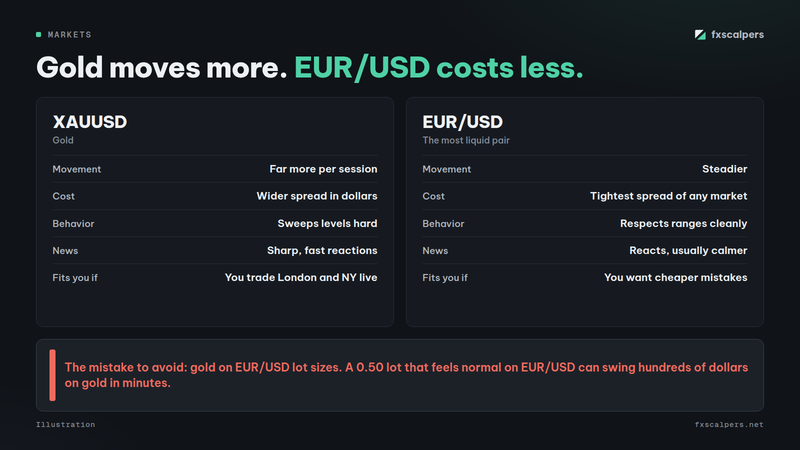
The logic works, but EUR/USD’s biggest window is often the London open. Gold is where the New York open really shines. Gold vs EUR/USD compares them.
Traps to avoid
- Market orders in the first two minutes after data, when spreads are widest.
- Moving the stop “just a bit” when a sweep runs further than expected. The stop was placed beyond the spike for a reason.
- Holding the winner into the London close hoping for more: momentum usually fades after 16:00 UTC.
The Free channel posts New York setups with the level, the stop and the target before the session, and flags data days in advance. Join and trade the open with a plan instead of a pulse rate.