Gold vs EUR/USD for scalping: which one fits you
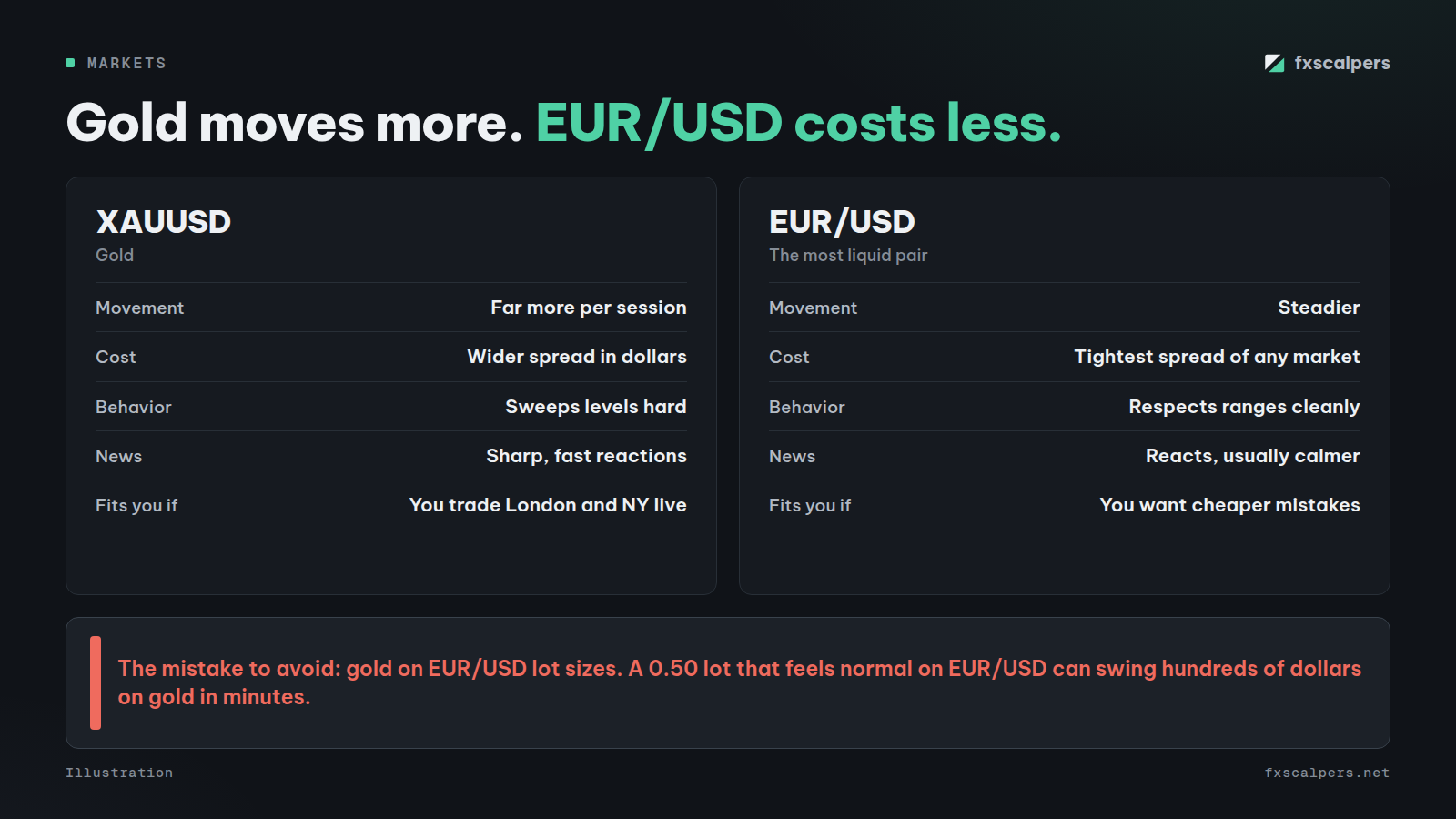
Gold moves more, EUR/USD costs less. Side by side on movement, cost, behavior and news, and the sizing mistake to avoid.
Most new scalpers start on EUR/USD because it’s “the safe pair”. Most of the traffic on trading TikTok is about gold because it moves. Both are excellent markets to scalp. They just reward different traders, different account sizes and different schedules. Pick the one that fits you and the learning curve gets shorter. Pick the wrong one and you pay tuition every single day.
The short version
- Gold (XAUUSD) covers far more ground per session, sweeps levels harder and reacts violently to US data. Bigger opportunity per hour, bigger damage per mistake.
- EUR/USD has the tightest spread of any market, respects ranges cleanly and forgives small errors. Cheaper mistakes, smaller moves.
- The market doesn’t decide your risk. Lot size and stop distance do. Size every trade from dollars at risk, whichever market you pick.
Side by side
Movement
Gold routinely travels several times further in a London or New York session than EUR/USD does in pip terms relative to its price. A quiet day on gold can still offer two or three clean swings. A quiet day on EUR/USD can be a 25 pip box that never pays for the spread. That extra movement is the whole attraction of gold for scalpers: targets get hit faster, and one good setup can make the day.
The flip side is the same movement working against you. A stop that feels comfortable on EUR/USD gets tagged in seconds on gold when US data drops.
Cost
EUR/USD usually carries the tightest spread of anything you can trade. On a Raw account it can sit at a fraction of a pip for most of the day. Gold’s spread is wider in dollar terms, and it widens further around news and at the daily rollover. That changes the math for small targets. A scalp aiming for a few dollars on gold has to clear a bigger cost before it makes a cent. See Raw vs Standard for the full calculation.
Behavior around levels
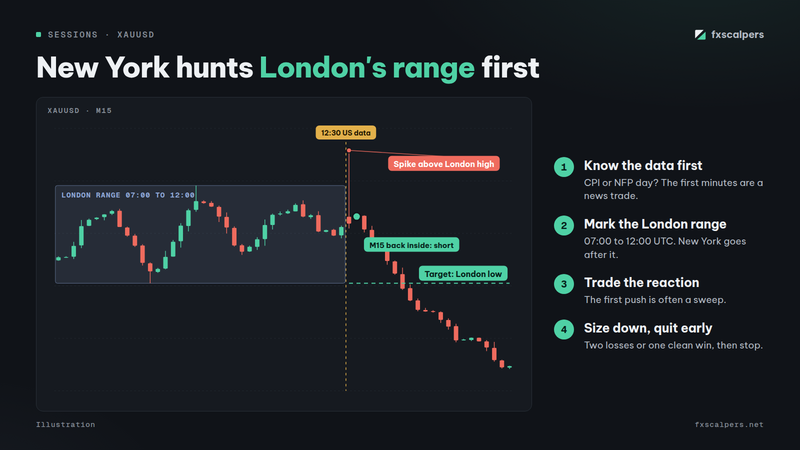
EUR/USD tends to respect highs, lows and ranges cleanly. Breakouts from the Asian box and pullbacks to broken levels are textbook. Gold is more aggressive: it overshoots obvious highs and lows to grab the stops sitting there, then snaps back. On gold, learning to tell a sweep from a breakout is not optional.
News sensitivity
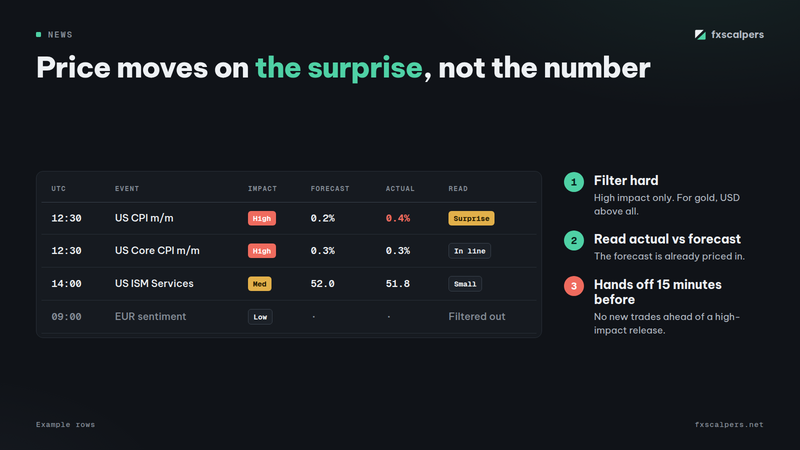
Both react to US data, but gold’s reaction is usually sharper and faster, because inflation and rate expectations hit gold directly through the dollar and real yields. The CPI chain explains why. EUR/USD also reacts to European data, which gives it a second news calendar to respect.
Gold fits you if
- You can trade the London and New York sessions live, especially the overlap.
- You size strictly from risk and accept wider stops measured in dollars.
- You prefer fewer, bigger moves to many small ones.
- You can sit on your hands through CPI, NFP and the Fed instead of gambling on them.
EUR/USD fits you if
- You’re still building consistency and want cheaper mistakes while you learn.
- You trade breakout and range setups like the London Breakout.
- Your account is small and you need tight, cheap stops to keep risk per trade low.
- You want a market that behaves close to the textbook while your rules settle in.
A worked example: same risk, two markets
Take a $2,000 account risking 1% per trade: $20.
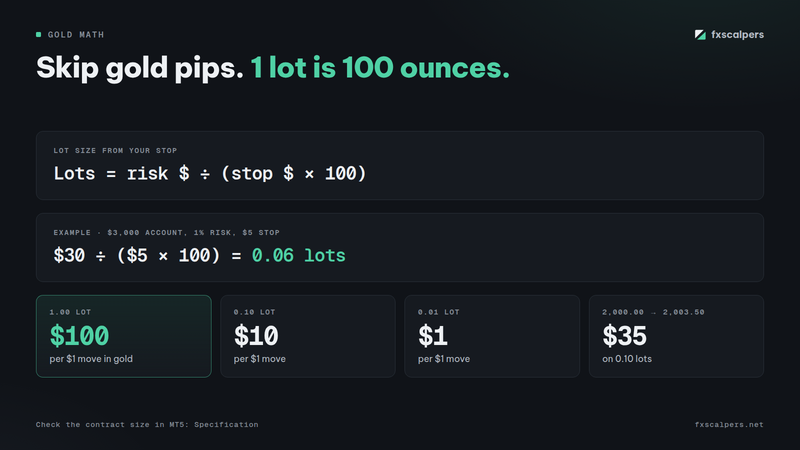
EUR/USD. The setup needs a 15 pip stop. One pip is worth $10 per standard lot, so the stop costs $150 per lot. $20 ÷ $150 = 0.13 lots.
Gold. The setup needs a $4 stop. One lot of XAUUSD is 100 ounces, so a $4 move costs $400 per lot. $20 ÷ $400 = 0.05 lots.
Same $20 at risk, very different lot sizes. That’s the entire point. If you had carried 0.13 lots over to gold out of habit, the same stop would have cost $52, more than two and a half times the plan. The gold pip value guide shows why gold math is simpler in dollars than in “pips”.
The mistake to avoid
Trading gold with EUR/USD position sizes. A 0.50 lot position that feels normal on EUR/USD can swing hundreds of dollars on gold in a few minutes. Traders who switch markets without switching their sizing are the ones who blow up in their first gold week and conclude that “gold is rigged”. It isn’t. The size was wrong.
The fix takes two seconds: size from risk and stop distance with the lot size calculator before every trade, on every market.
Traps to avoid on both
- Trading the dead hours. Gold in late Asia and EUR/USD after the New York close both offer spread without movement. See the best time to trade gold.
- Holding scalps into rollover. Spreads widen sharply around 21:00 UTC. A tight stop can be taken out by the spread alone. Here’s why.
- Switching markets after a loss. Jumping from EUR/USD to gold because “it moves more” right after a red trade is revenge trading with extra steps.
- Judging a market on one week. Give each market at least 30 trades with the same rules before deciding which one suits you.
How to decide in one week
- Pick one setup you know well, for example a retest of a broken level.
- Mark it on both markets every day for five days, in the same session.
- Write down how many valid setups each market produced, how far price went in your favor and how often it swept your stop first.
- Compare the results in R, not in dollars.
Most traders find the answer is obvious by Friday. Some also find the answer is “both, in different sessions”: EUR/USD at the London open, gold at the New York open.
Watch both before you choose
Quick FAQ
Which one is better for a small account?
EUR/USD usually, because tight stops stay cheap. Gold is fine on a small account only at small lot sizes calculated from risk.
Can I trade both?
Yes, ideally in different sessions and with separate lot size math for each. Never carry one market’s lot size into the other.
The Free channel posts setups on gold and the majors with the entry, stop and target before price gets there, plus the reason behind each one. Follow a week of calls on both markets and you’ll see how differently they move around the same kind of level, without risking a cent to learn it.