Sweep or breakout? How to tell on gold before you get trapped
Gold punches through yesterday’s high and half the market buys it. Four tells of a sweep, three tells of a real breakout, and how to trade each.
Gold punches through yesterday’s high. Half the market buys the breakout. Twenty minutes later price is $8 lower and all those buyers are stopped out. Was it a breakout that failed, or a sweep that worked exactly as designed? Learn to tell the difference and you stop being the liquidity, and start trading against the people who are.
The short version
- A sweep pushes beyond an obvious level to trigger the orders sitting there, then reverses. A breakout pushes through and keeps going.
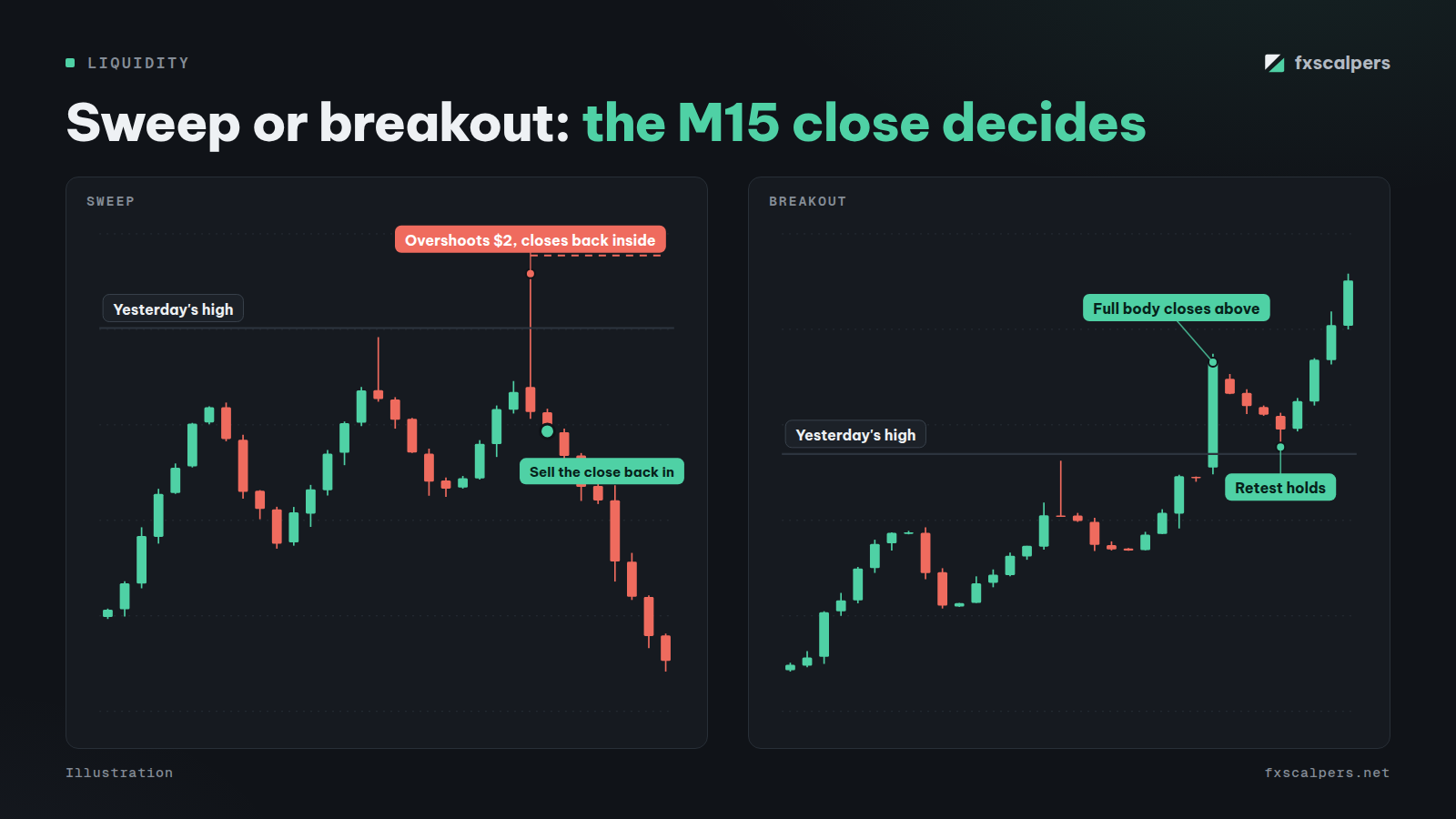
- The most reliable tell: where the M15 candle closes. Back inside is a sweep; a full-body close beyond, held by the next candle, is a breakout.
- Trade the sweep on the close back inside; trade the breakout on the retest.
What a sweep is
Above every obvious high sits a cluster of orders: stop losses from traders who are short, and buy stops from breakout traders waiting to join. Below every obvious low, the mirror. Big players who want to sell size need buyers to sell into, and that cluster above the high is a pool of buyers. A sweep is price pushing into that pool, filling the big sell orders, then falling back once the pool is drained.
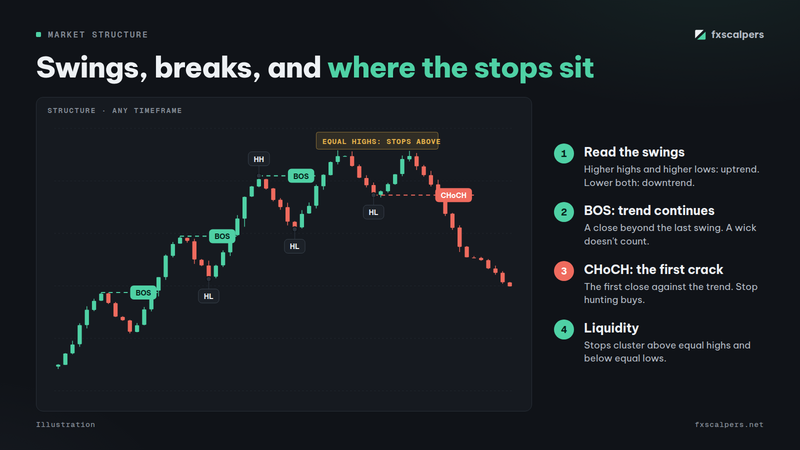
That’s why sweeps happen at the most obvious levels: yesterday’s high and low, the Asian range, equal highs, round numbers. Market structure without the jargon covers where liquidity sits.
Four tells of a sweep
1. The candle closes back inside
On M15, price trades above the high but the candle closes below it. The most reliable tell of all. The breakout buyers who entered above the level are now trapped.
2. Short push, fast rejection
A sweep on gold usually overshoots the level by $1 to $3, not $10. A real breakout keeps going. If price barely clears the level and snaps back within one or two candles, that’s a grab, not a trend.
3. It happens at a session open
The first 30 minutes of London and New York are when liquidity pools get hunted most. New volume arrives and goes straight for the obvious stops. The New York open is the classic example.
4. It runs against the higher timeframe
A push above the high while H4 structure is bearish is far more likely a sweep than the start of a new trend. The bigger picture usually wins.
Three tells of a real breakout
- M15 closes above the level with a full body, small upper wick, and the next candle holds above it.
- The retest of the broken level holds as support. Price comes back, touches the old high from above, and bounces.
- It runs in the direction of H4 structure. A break that agrees with the bigger trend has the wind behind it.
How to trade each one
Sweep
- Entry: on the M15 close back inside the range, or on a retest of the swept level from below.
- Stop: above the sweep high plus a buffer (on gold, often $1 or more).
- Target: the opposite side of the range, or the next liquidity level.
Breakout
- Entry: on the retest of the broken level, not on the breakout candle. Why chasing loses.
- Stop: back inside the range, below the retest low plus a buffer.
- Target: the next resistance or a measured move.
A worked example
Yesterday’s high on gold: 2,350. At the London open, price pushes to 2,352.40 on one M15 candle, then that candle closes at 2,346.30, back below the level. Next candle confirms lower. Sell at 2,346 with a stop at 2,353.20, targeting the Asian low at 2,338: about $7 risk for $8 reward, with the trapped buyers’ stops below adding fuel.
Same level, different day: an M15 candle closes at 2,355.40, full body, and the next one holds above 2,353. Price pulls back to 2,350.40, holds, and runs to 2,360. The retest buy at 2,350.80 with a stop at 2,347.50 made nearly 3R. Illustrative prices; the close told you which trade to take both times.
Traps to avoid
- Entering on the first poke above the level. That’s exactly the order a sweep feeds on.
- Shorting every new high. In a strong uptrend, most breaks are real. The sweep trade needs the tells, especially the close back inside.
- Placing your stop right at the swept level. The next sweep takes it. Beyond the level, not on it.
- Using M1 closes. Too noisy on gold. M15 filters most of the fake closes.
Quick FAQ
How long should I wait for the retest on a breakout?
A few candles on your entry timeframe. If price runs without retesting, let it go. Another setup will come.
Can a sweep turn into a breakout?
Yes. If price closes back inside and then breaks out again with a strong close, the second break is often real. The stop above the sweep high is what protects you.
Does this work on EUR/USD?
The logic is identical; sweeps on EUR/USD are usually smaller and cleaner. Gold sweeps harder and deeper.
The Free channel posts sweep and breakout setups on gold with the level, the stop and the target before the session, plus the weekly plan that marks the liquidity pools in advance. Join and stop being the liquidity.