Market structure without the jargon: BOS, CHoCH and liquidity sweeps
Three questions decide everything: which way price is stepping, whether it stopped, and where everyone else’s stops are sitting.
Market structure gets buried under acronyms: BOS, CHoCH, MSS, OB, FVG. Strip the jargon away and it comes down to three questions. Which way is price stepping? Has it stopped stepping that way? Where are the stops everyone else placed? Answer those three and you already read charts better than most signal groups.
The short version
- Three questions decide everything: which way price is stepping, whether it stopped, and where everyone else’s stops sit.
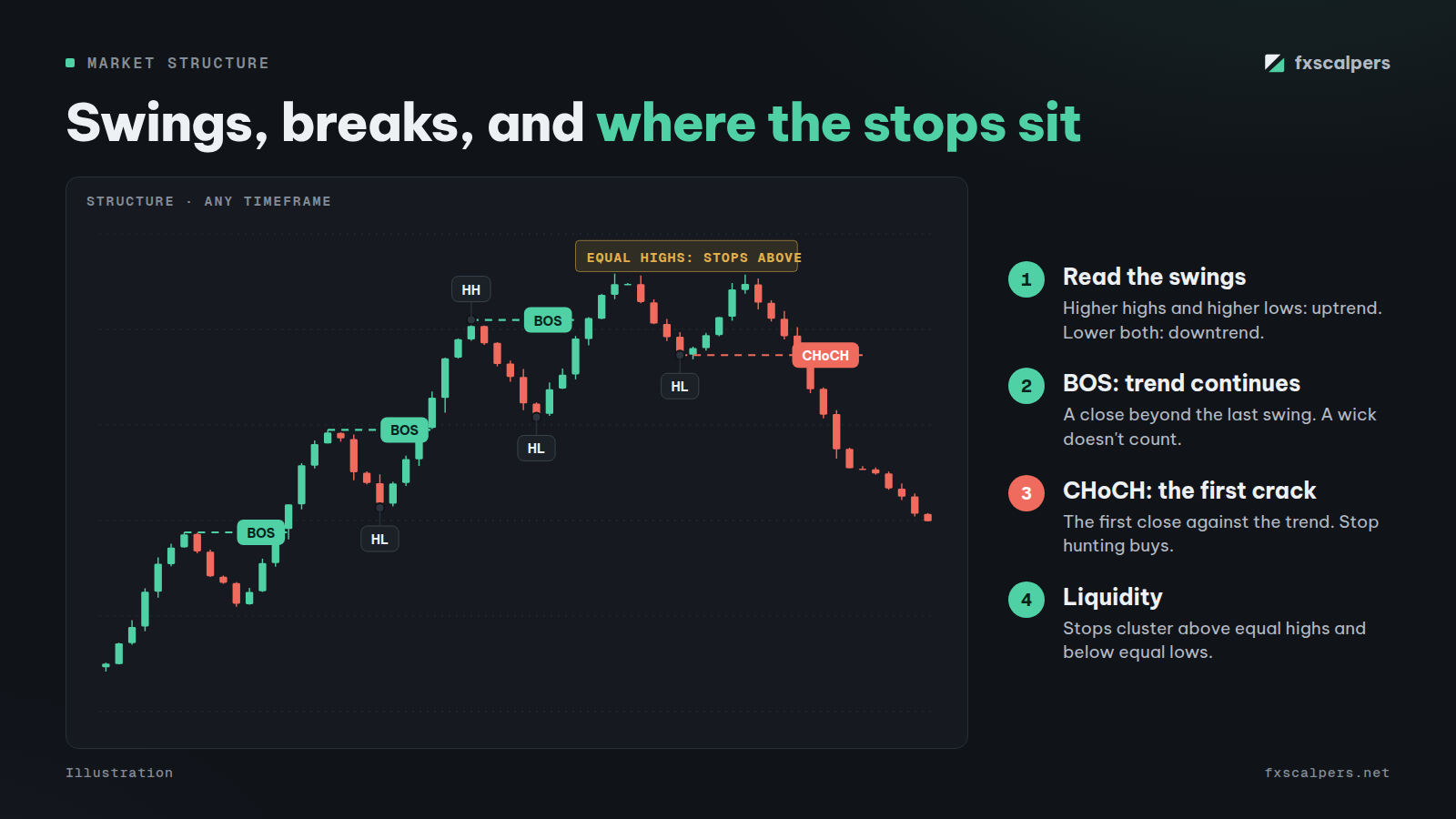
- BOS: a close beyond the last swing in the trend direction. CHoCH: the first close against it.
- Liquidity: stops cluster above equal highs, below equal lows, beyond the Asian range and round numbers. Price is drawn to them.
Swings: the only thing that matters
A swing high is a peak with lower highs on both sides. A swing low is a trough with higher lows on both sides. Everything in market structure is built from these points, so mark them first and ignore indicators until you have.
- Uptrend: higher highs and higher lows. Every pullback holds above the last low.
- Downtrend: lower highs and lower lows.
- Range: neither. Highs and lows repeat around the same levels.
BOS: the trend keeps going
A break of structure is a candle closing beyond the last swing high in an uptrend, or beyond the last swing low in a downtrend. It confirms the trend is still in control. A wick beyond the level is not a break. Only the close counts.
CHoCH: the first crack
A change of character is the first break against the trend. In an uptrend, that’s a close below the last higher low. It doesn’t guarantee a reversal, but it tells you the buyers just lost the level they had to defend. From that moment, stop hunting buys on that timeframe.
Liquidity: where the stops sit
Retail traders put stops in the same obvious places: just above equal highs, just below equal lows, just beyond the Asian session range, just past round numbers. Those clusters are liquidity. Big orders need liquidity to fill, so price is drawn to those levels.
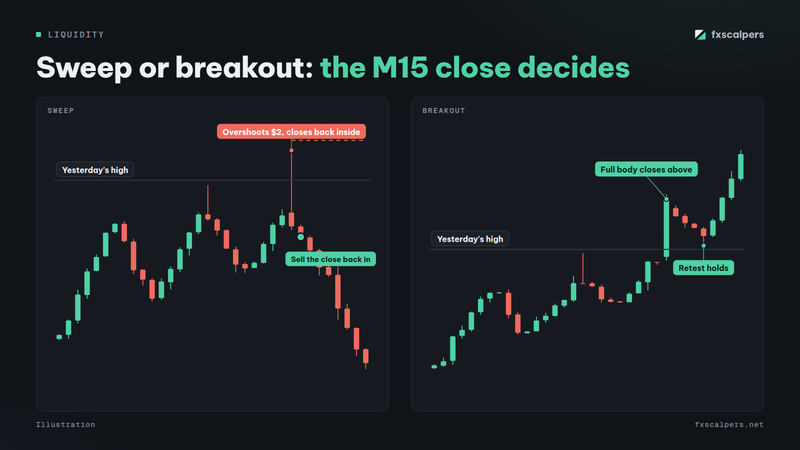
A sweep is price pushing through one of those clusters, triggering the stops, then closing back on the other side. The candle that sweeps and closes back inside is often where the real move starts. That’s the difference between a breakout you chase and a sweep you fade.
Putting it together
- Read the bias on H4: is structure stepping up or down, and where was the last BOS or CHoCH?
- Mark the liquidity pools in the direction of that bias: equal highs, the Asian range, yesterday’s high or low.
- Drop to M15 and wait for price to sweep a pool, then show a CHoCH back in the H4 direction.
- Enter on the pullback after that CHoCH. Stop beyond the sweep. Target the next pool on the other side.
That’s the exact logic behind the weekly Market Structure plan in the Free channel: bias, pools, and the zone where a setup is allowed to form.
A worked example, top down
H4: gold has made higher highs and higher lows for a week; the last BOS broke the high at 2,340. Bias: long.
Liquidity: the Asian session left equal lows at 2,331. Below them sit the stops of everyone who bought the Asian dip.
M15: at the London open price drops to 2,329.60, sweeping the equal lows, and the candle closes back above 2,331. Twenty minutes later M15 closes above the last lower high at 2,335.40: a CHoCH back in the H4 direction.
Entry: on the pullback after the CHoCH, around 2,333. Stop: beyond the sweep low, 2,328.60. Target: the next pool on the other side, yesterday’s high at 2,344. About $4.40 risk for $11 reward. Illustrative prices; the sequence is the lesson: bias, pool, sweep, CHoCH, pullback.
Where FVG and order blocks fit
A fair value gap is a three-candle imbalance, a range traded only once during a fast move. An order block is the last opposite candle before a move that breaks structure. Both are places where the pullback after a BOS or CHoCH often reacts. They refine the entry; they don’t replace the structure read. Order blocks with strict rules shows how.
Traps to avoid
Marking every wiggle as a swing. If you’re on M5 and see 30 swing points in a morning, you’re reading noise. Mark swings on the timeframe you use for bias, and only the obvious ones. If you have to squint, it isn’t a swing.
Quick FAQ
Which timeframe should I mark structure on?
Bias on H4, execution on M15 or M5. Mark swings on the timeframe you use for bias, and only the obvious ones.
Does a wick beyond the swing count as a BOS?
No. Only the close counts. A wick beyond the level followed by a close back inside is a sweep.
Where do I learn the terms fast?
The trading glossary defines every term used here in plain English.