FOMO entries: how to stop chasing candles
Buying the top of a candle you missed is the most common way good analysis turns into a bad trade. Four rules that kill FOMO.
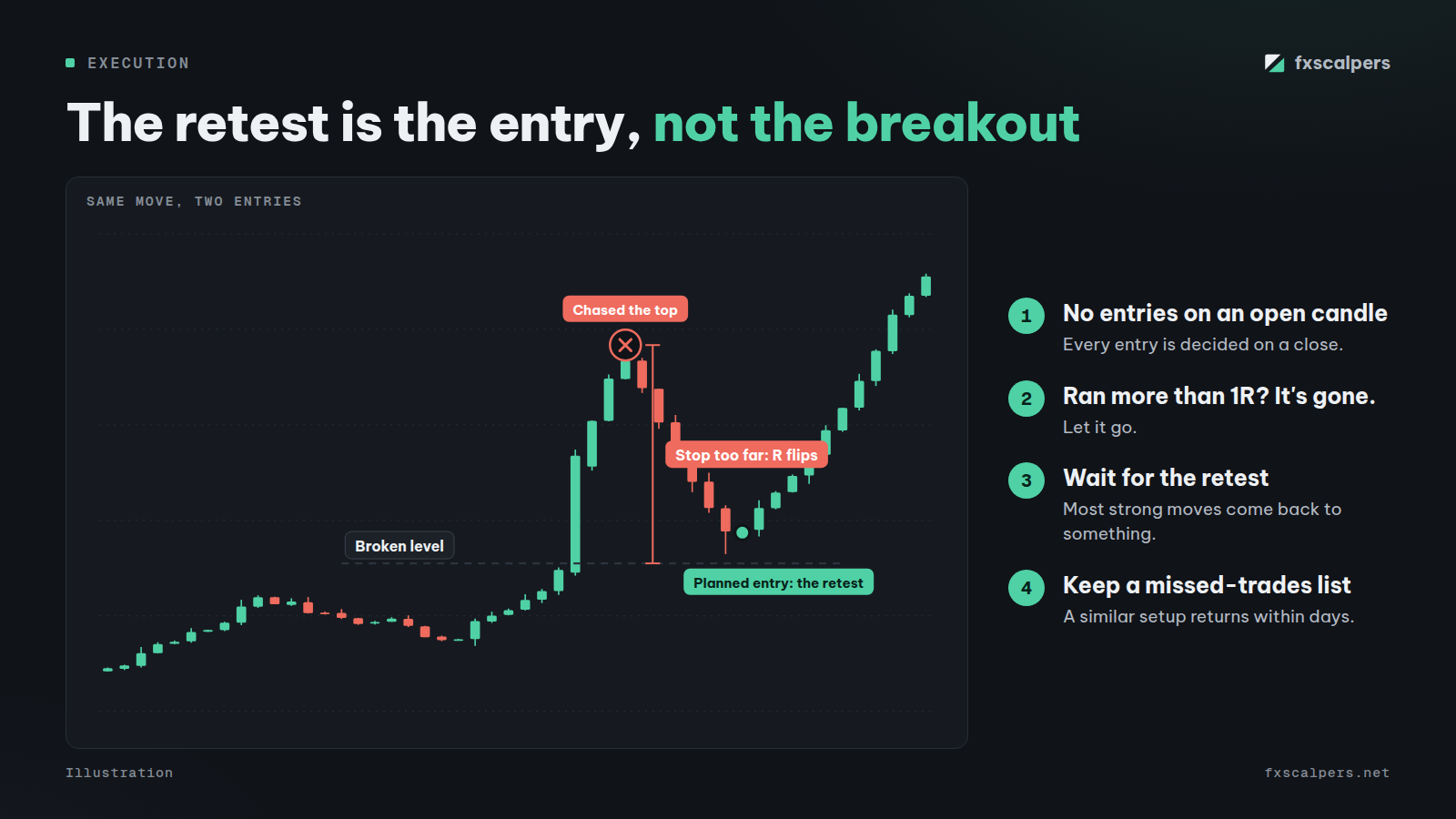
A big green candle rips through a level. You didn’t get in. Every second it keeps going feels like money leaving your pocket, so you buy the top of the candle. Price pulls back and you’re instantly in the red. That’s FOMO, and it’s the most common reason good analysts make bad entries. The analysis was right. The price you paid was wrong.
The short version
- Chasing puts your entry at the most extended point of the move, far from any logical stop.
- Four rules kill it: entries only on a candle close, a 1R “it’s gone” limit, the retest is the entry, and a missed-trades list.
- A missed trade costs nothing. A chased trade costs money.
Why chasing loses
Every trade has three prices that matter: the entry, the stop and the target. The stop belongs where the idea is wrong, usually beyond the level that just broke. When you enter near the start of the move, that stop is close and the target is far. When you enter at the top of the breakout candle, the level is now far below you.
That leaves two bad options:
- Keep the logical stop beyond the broken level. It’s now far away, so either the position has to be tiny, or you oversize and risk far more than planned.
- Use a tight stop just under the candle. It isn’t at any level that means anything, so the first normal pullback hits it.
Either way your risk-to-reward flips. The target is often closer than the stop. You need a much higher win rate just to break even, on the trades you’re taking at the worst possible price.
A worked example
EUR/USD breaks above 1.0850 on a strong M5 candle. The planned entry was a retest of 1.0852 with a stop at 1.0838 (below the retest low) and a target at 1.0892: 14 pips of risk for 40 pips of reward, nearly 3R.
You missed the break and bought at 1.0871, the top of the next candle. The logical stop is still 1.0838: now 33 pips of risk for 21 pips of reward. Less than 0.7R. Same analysis, same direction, same target, and the trade went from excellent to bad purely because of where you clicked.
Twenty minutes later price pulled back to 1.0853, then ran to 1.0892. The patient trader got the full 3R. The chaser either got stopped out on a tight stop during the pullback or sat through a painful drawdown for less than 1R.
Rules that kill FOMO
1. No entries on a candle that is still open
Every entry is decided on a close. An open candle can print anything: the huge body you’re chasing can end as a long upper wick three minutes later. Waiting for the close costs a few pips occasionally and saves you from buying tops that never close.
2. If price has run more than 1R from your planned entry, the trade is gone
Measure it. If the stop was going to be 12 pips and price is already 12 pips past your entry zone, you’ve lost the trade. Let it go. That’s not weakness; it’s the math from the example above.
3. The retest is the entry, not the breakout
Most strong moves come back to something: the broken level, the middle of the breakout candle, an imbalance left behind, the fast EMA. Plan the entry there in advance with a limit order or a close-back-up trigger. When the retest doesn’t come, you miss the trade. That’s fine. See rule 4.
4. Keep a missed-trades list
Write down every setup you missed: date, market, setup, where it went. After a month you’ll see that a similar setup comes back within days, often within the same week. That list takes the urgency out of every single move, because you have proof that the market prints new chances constantly.
What FOMO looks like before you click
- You’re watching the M1 chart while your setup is on M15.
- You’re thinking about how much the move has already made instead of where the stop goes.
- You’re about to use a market order when your plan says limit order.
- You’re increasing size to “make up” for the part of the move you missed.
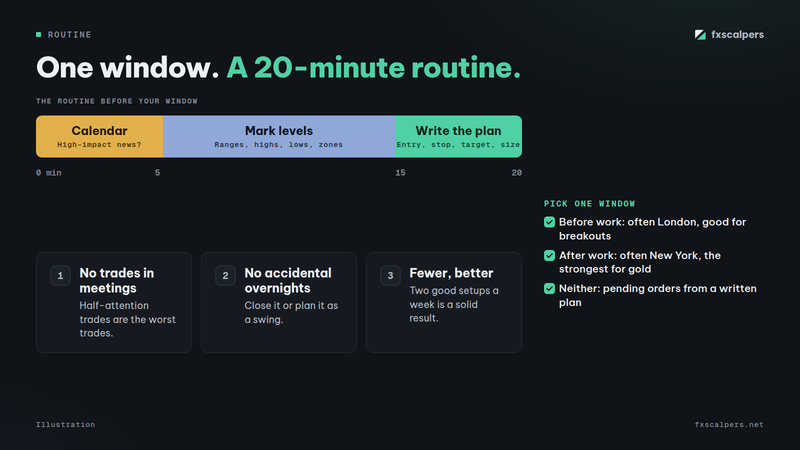
Two of these at once is the signal to take your hand off the mouse. The tilt checklist uses the same idea for losing streaks.
Traps to avoid
- Chasing news spikes. The first minutes after CPI or NFP have the widest spreads of the day. Chasing there pays the highest fee for the worst price. The news spike fade is the disciplined alternative.
- Moving the entry instead of cancelling. Dragging your limit order up to “just get filled” is chasing in slow motion.
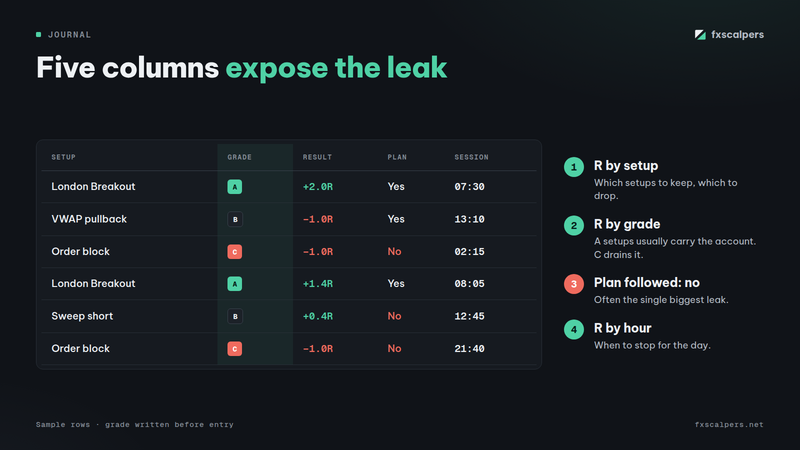
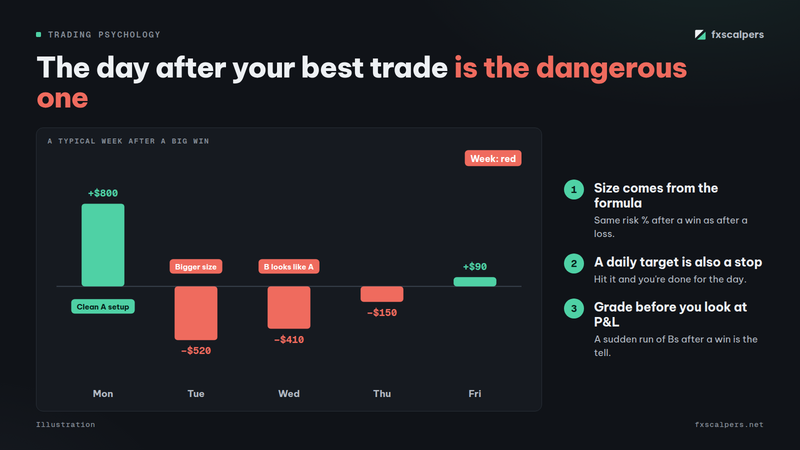
- Chasing after a win. Confidence makes extended entries look safe. They aren’t. Why you trade worse after a big win explains the effect.
- Tightening the stop to make the chase “fit”. A stop that isn’t at a level is just a donation to the next pullback. Where the stop really belongs.
The reframe that helps
A missed trade costs nothing. A chased trade costs money. Your job isn’t to catch every move; it’s to take the ones that meet your rules at a price that makes sense. The market prints new setups every session, in every market, forever.
Quick FAQ
What if price never retests?
Then you miss the trade. Strong moves without a retest happen; they’re not worth the chased entries you’d take trying to catch them.
Is a limit order at the retest better than waiting for a close?
Both work. A limit order gets the best price but sometimes fills on a move that keeps going against you. A close-back trigger confirms first. Pick one and log it.
That’s also why setups in the Free channel are posted with an entry zone before price gets there: you’re waiting for price to come to you, not running after it. Join, set the alert at the zone, and let the market do the moving.