The best time to trade gold (and the hours to avoid)
Most of XAUUSD’s daily range prints in two windows. When they are in UTC, where scalpers get hurt, and a simple daily routine.
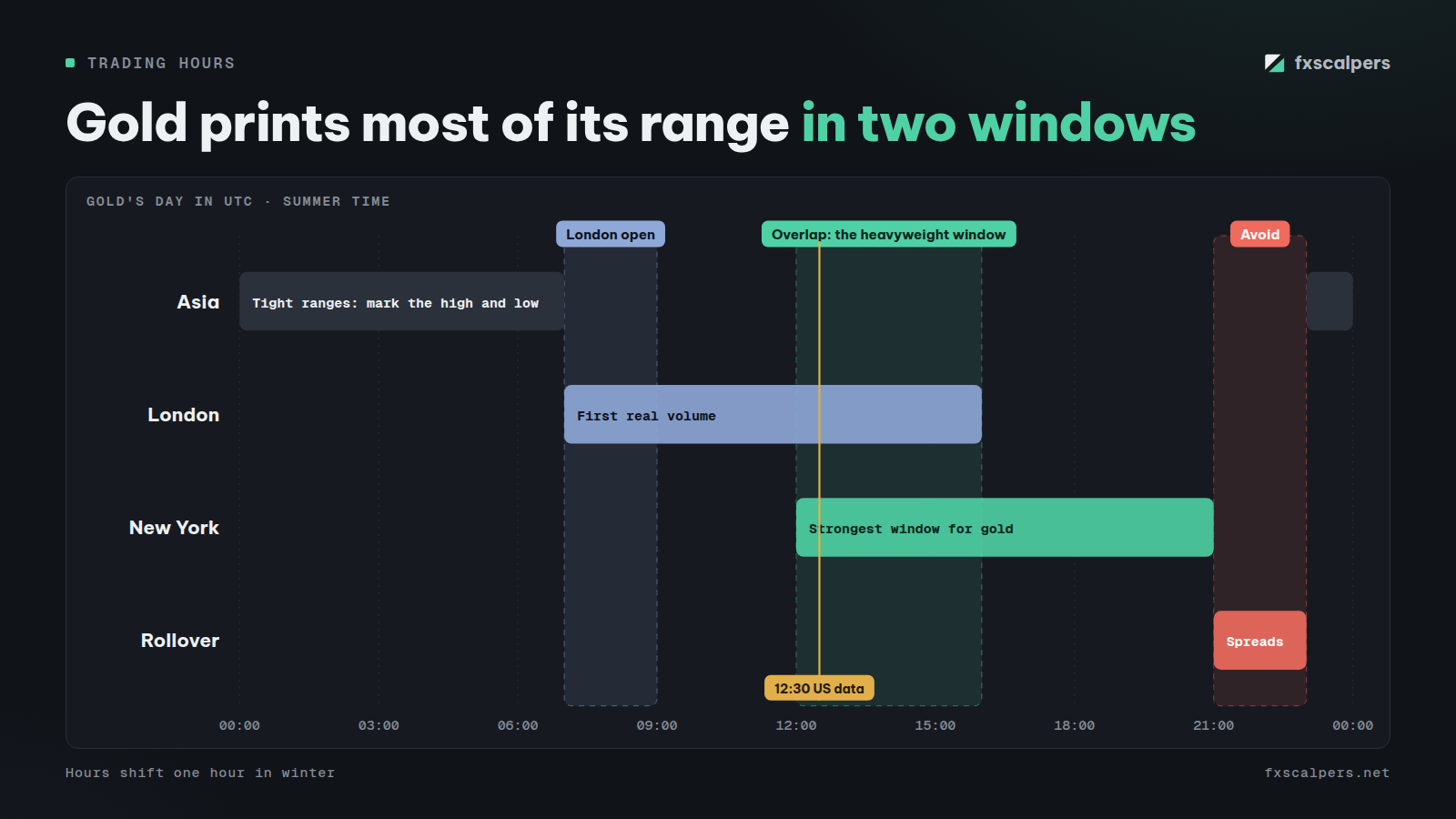
Gold trades almost around the clock, but it doesn’t move around the clock. Most of XAUUSD’s daily range gets printed in two windows. Trade inside them and your setups have room to work. Trade outside them and you’re paying the same spread for a fraction of the movement, while waiting for a target that the market has no energy to reach.
The short version
- Asia (about 23:00 to 07:00 UTC): tight ranges. Mark the high and low; don’t scalp it.
- London open (07:00 UTC in summer, 08:00 in winter): the first real volume and the first trend of the day.
- London and New York overlap (about 12:00 to 16:00 UTC): the heavyweight window. US data lands here.
- Avoid: the daily rollover around 21:00 UTC, the first minutes after US data, and Friday afternoon in New York.
The three phases of a gold day
Asia: build the range
Roughly 23:00 to 07:00 UTC. Tokyo, Singapore and Hong Kong are active, but the big gold volume sits in London and New York. Ranges are tight, books are thin, and moves are often slow drifts that reverse. The Asian high and low become the levels London hunts later, which makes this session great for marking liquidity and poor for scalping.
London: the first wave
From 07:00 UTC in summer (08:00 in winter). European banks and funds arrive and volume jumps. The Asian range gets tested, usually one side first, and the first trend of the day often starts here. Many of the day’s cleanest setups form in the first two hours: sweeps of the Asian high or low, then breaks of structure in the other direction.
The overlap: the heavyweight window
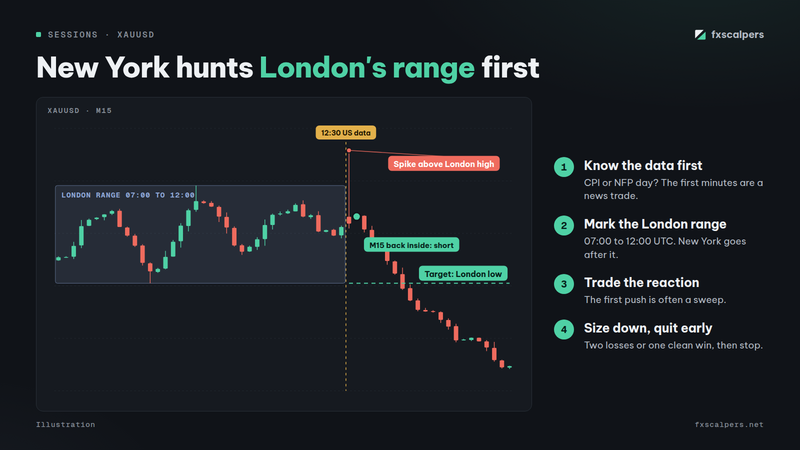
About 12:00 to 16:00 UTC, when London and New York are both open. US data lands at 12:30 or 13:30 UTC depending on the season, US equities open an hour later, and gold routinely makes a large share of its daily range in these hours. It’s the best window of the day and also the fastest; the rules in scalping gold at the New York open exist for a reason.
After London closes (15:30 to 16:30 UTC), gold’s pace usually cools. Late New York can still trend, but moves thin out into the evening.
Where scalpers get hurt
- 21:00 to 23:00 UTC: the daily rollover. Spreads widen, sometimes a lot. Stops placed tight can get tagged by the spread alone. Full explanation.
- The first minutes after US data: spreads blow out and fills slip. Unless you trade a specific news setup such as the news spike fade, wait it out.
- Friday afternoon New York: liquidity drains into the weekend, moves get erratic, and positions carried into Monday face gap risk.
- Holidays: a US or UK holiday removes half the market. Ranges shrink and spikes come from nowhere.
Summer and winter time
Session times shift when London and New York change their clocks, and they don’t change on the same weekend. For a couple of weeks each spring and autumn, the overlap is an hour shorter or longer than usual. Don’t memorize UTC times; use the market sessions clock, which calculates every session in its own city’s local time and shows it in yours.
A simple daily routine
- Before London: mark the Asian high and low, yesterday’s high and low, and any round numbers nearby.
- Check the calendar for US data and note the exact release time in UTC. How to read it.
- Trade London’s first move only if it gives a clean setup at one of your levels.
- Step back through the London lunch lull, roughly 10:30 to 12:00 UTC, when ranges tighten.
- Trade the New York open with the London range marked as the next liquidity target.
- Stop before 16:30 UTC unless a setup is already running.
A worked example of the day’s shape
Asia ranges between 2,318 and 2,324. At the London open, gold dips to 2,316.50, sweeping the Asian low, then closes back inside on M15 and rallies to 2,329 by 10:00 UTC. The lunch hours drift between 2,325 and 2,329. At 12:30 UTC US data hits: a spike to 2,334, then a pullback, then a trend to 2,338 by 15:00. After 16:00 the range compresses again. Illustrative levels, but it’s the typical shape: two windows carry most of the move, and the hours between them mostly cost spread.
Quick FAQ
Can I trade gold in the Asian session at all?
You can, with range tactics and small targets, but spread eats a bigger share of every trade. For most scalpers, Asia is homework time: mark the levels.
What if I can only trade in the evening?
Depending on your time zone, the evening may be the New York session, the strongest window for gold. If it’s after the New York close, use pending orders from a plan. Trading around a day job covers this.
Is Monday different?
Mondays often start slower as the market digests weekend news, and the weekly open can gap. The Sunday plan matters most on Monday.
Traps to avoid
- Forcing trades in the lunch lull because the morning was good.
- Assuming every US session is the same: CPI and NFP days behave nothing like quiet Tuesdays.
- Holding a scalp into rollover because it’s “almost at target”.
Setups in the Free channel land inside the windows where gold actually moves, and the weekly Market Structure plan marks the liquidity levels the sessions will hunt. Join and let the clock work for you.