Raw vs Standard account: the math that decides which one is cheaper
It isn’t a gut-feeling question. On gold the gap can be $13 a lot. Here’s how to run the numbers for your own trading.
Brokers love the question “Raw or Standard?” because most traders pick by gut feeling. It’s not a feeling question. It’s arithmetic, and the answer depends on what you trade and how much. On gold, the gap can be $13 a lot. Over a year of active trading, that’s real money for doing nothing differently.
The short version
- Standard: no commission, wider spread. Raw/ECN: tight spread plus a fixed commission per lot, usually $6 to $8 round turn.
- Raw is cheaper when raw spread + commission is less than the standard spread. For active scalpers, it usually is.
- Run the math with your own spreads, measured at the hours you trade, not the broker’s headline number.
How the two accounts charge you
Standard. No commission. The broker’s fee is built into a wider spread. Simple to read: the spread you see is the whole cost.
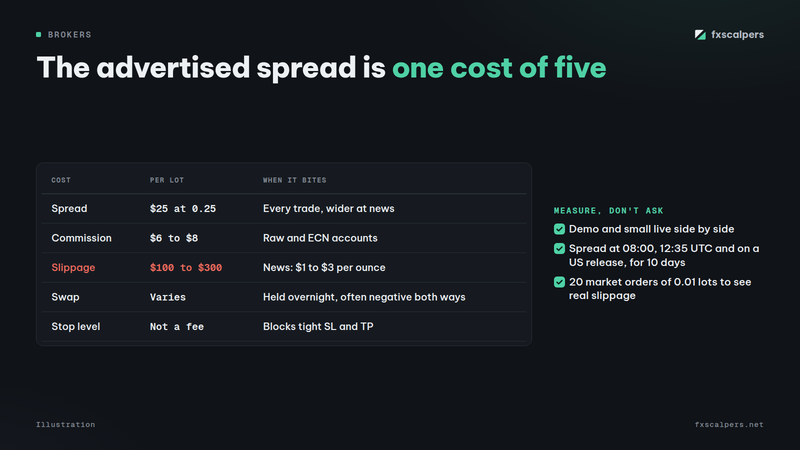
Raw / ECN. A spread close to the raw interbank price, plus a fixed commission per lot, usually $6 to $8 round turn (entry plus exit). The spread is smaller, but you pay the commission on every lot regardless.
So the comparison is simple:
Raw is cheaper when raw spread + commission < standard spread.
Gold example
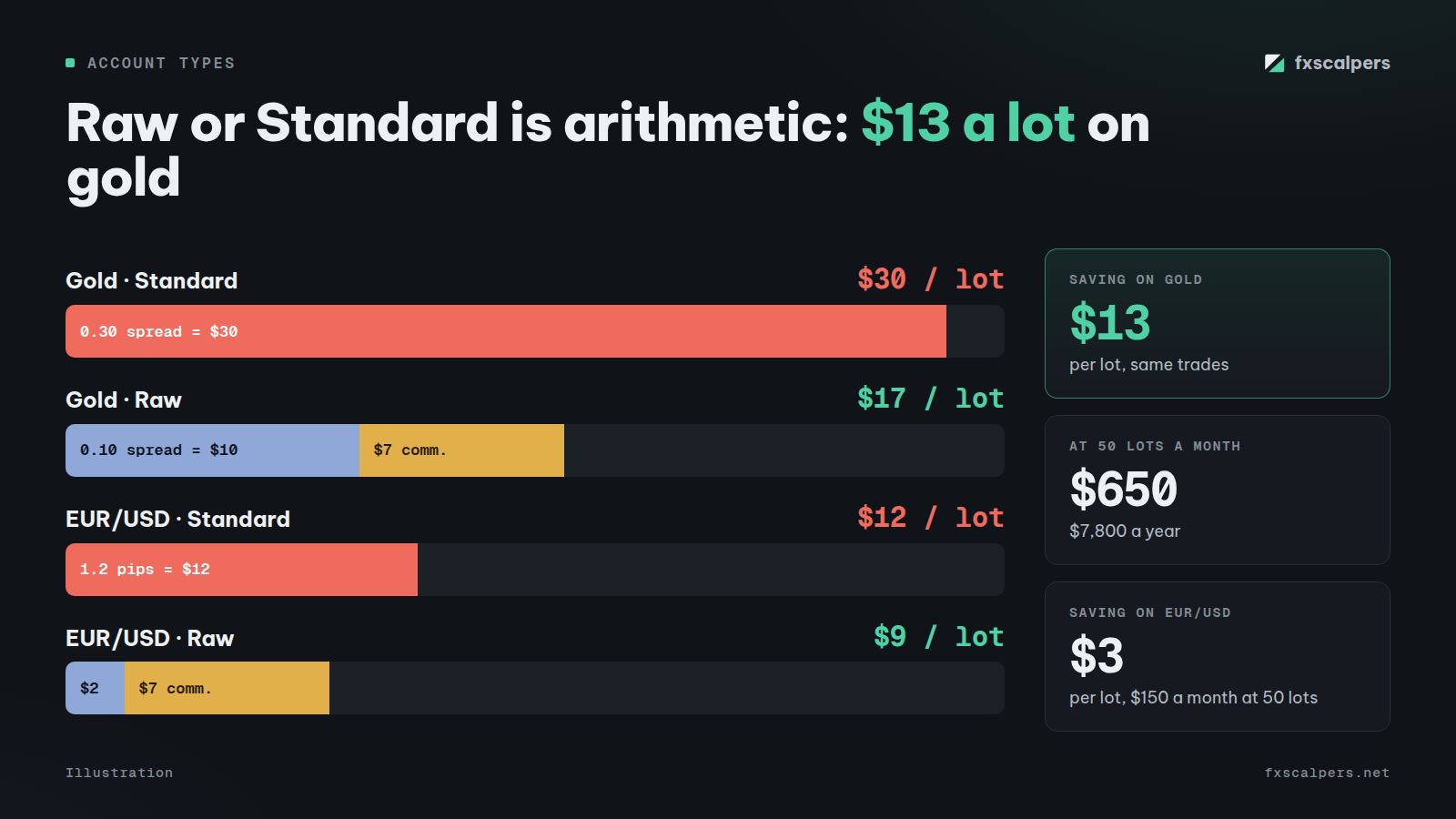
- Standard: 0.30 spread on XAUUSD = $30 per lot (0.30 × 100 ounces).
- Raw: 0.10 spread = $10 per lot, plus $7 commission = $17 per lot.
- Saving on Raw: $13 per lot.
At 50 lots a month, that’s $650 a month, $7,800 a year. Same trades, same results in pips, same analysis. Just the right account.
EUR/USD example
- Standard: 1.2 pip spread = $12 per lot.
- Raw: 0.2 pip spread = $2 per lot, plus $7 commission = $9 per lot.
- Saving on Raw: $3 per lot.
A smaller gap than gold, but still $150 a month at 50 lots.
What it means per trade
Cost matters most when targets are small. A gold scalp targeting $3 per ounce on 0.50 lots makes $150 gross. On Standard, cost is $15 (10% of the target). On Raw, $8.50 (under 6%). Across hundreds of trades, that difference decides whether a thin edge shows up in the account or disappears into fees. That’s also why choosing a gold broker is about more than the advertised spread.
When Standard still wins
- Very small size. If you trade a few micro lots a month and the Raw account needs a high minimum deposit you can’t reach comfortably, the saving isn’t worth tying up capital.
- News trading on a broker whose Raw spread explodes. Some brokers’ Raw spreads widen far more than their Standard spreads during news. If you trade news, measure it; don’t assume.
- A Standard spread that’s genuinely tight. Some brokers run very competitive Standard accounts. Run the numbers rather than trusting the label.
- Rebates. Rebate levels can differ between account types at the same broker. Always add the rebate into the math.
Do the math for your own trading
- Pull last month’s total lots per instrument from your MT5 history.
- Measure the average spread on both account types at the hours you actually trade (for example 08:00 and 12:35 UTC), not the quietest minute of the day.
- Cost per lot = spread in dollars + commission − rebate.
- Multiply by your monthly lots on each instrument, and compare.
Ten minutes of work, and the answer usually isn’t close.
Quick FAQ
Is commission charged on both entry and exit?
“Round turn” means the quoted figure covers both. Some brokers quote per side; double it to compare.
Does the account type change execution?
Sometimes. Raw accounts are often aimed at active traders and may route orders differently. Compare slippage too, with small live orders at your trading hours.
Can I switch accounts later?
Usually yes, by opening a second account of the other type. Test both side by side for a week before moving your main balance.
Traps to avoid
- Comparing a Raw spread at 03:00 UTC with a Standard spread at the New York open.
- Forgetting that commission is per lot: large sizes multiply it, small sizes shrink it.
- Choosing by the account name instead of the numbers.
Not sure which account fits your volume? Account Support runs this calculation for you before you open, and the Free channel posts the setups that make the volume worth it.