Choosing a broker for gold: don’t just look at the spread
The five costs of a gold trade, and how to measure your real cost at the hours you actually trade before picking a broker.
When a broker advertises gold spreads “from 0.1”, they’re describing one moment of the day, usually the quietest one. Scalpers don’t trade that moment. Scalpers trade the New York open, the news release, the three minutes gold runs $10. The real cost lives in the moments the ad never mentions.
The short version
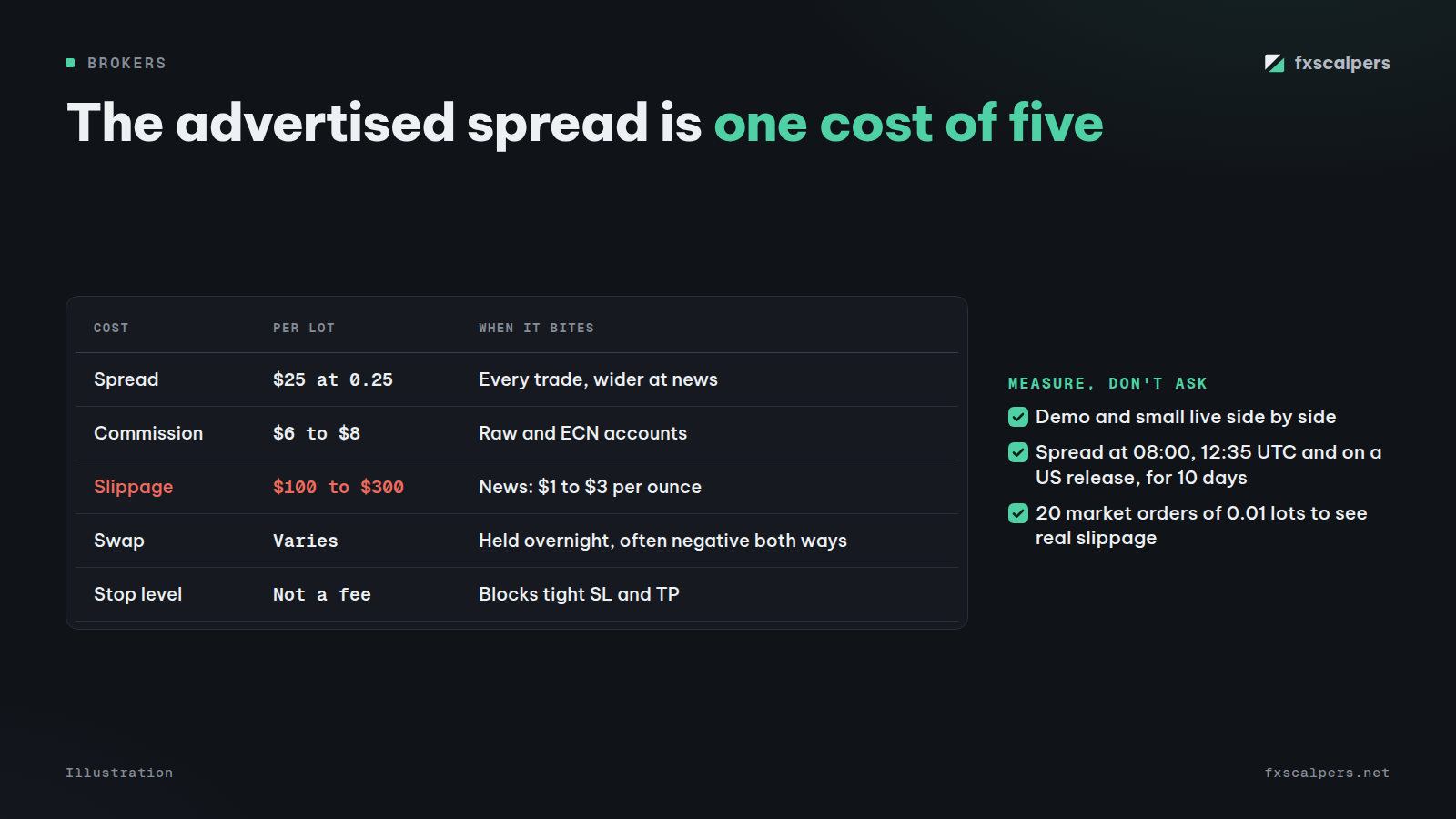
- A gold trade has five costs: spread, commission, slippage, swap and the stop level. The advertised spread is only the first.
- Measure them yourself for 10 days at the hours you trade: 08:00 UTC, 12:35 UTC and at a major US release.
- Compare brokers on cost per lot × lots per month, then on what money can’t measure: withdrawals, trade cancellations, license.
The five costs of a gold trade
- Spread. Measured in dollars per ounce. A 0.25 spread is $25 per lot, paid on entry.
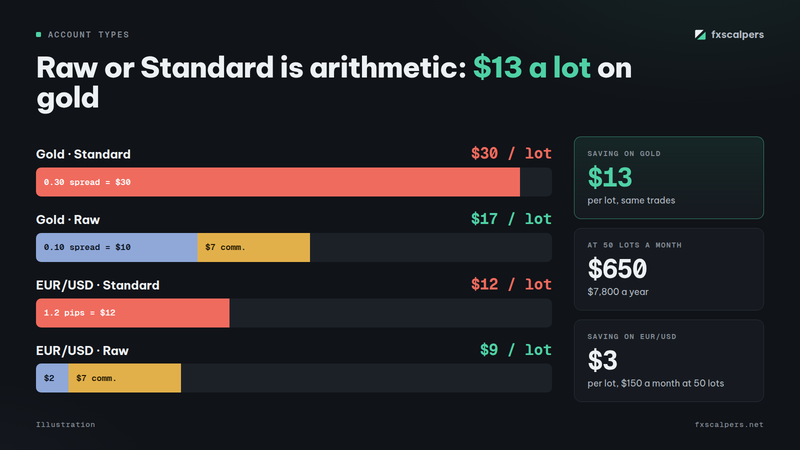
- Commission. ECN/Raw accounts usually charge $6 to $8 per lot round turn. A 0.10 spread plus $7 commission is $17 per lot, more expensive than a Standard account with a 0.15 spread and no commission.
- Slippage. The gap between the price you clicked and the price you got. During news, $1 to $3 per ounce, which is $100 to $300 per lot.
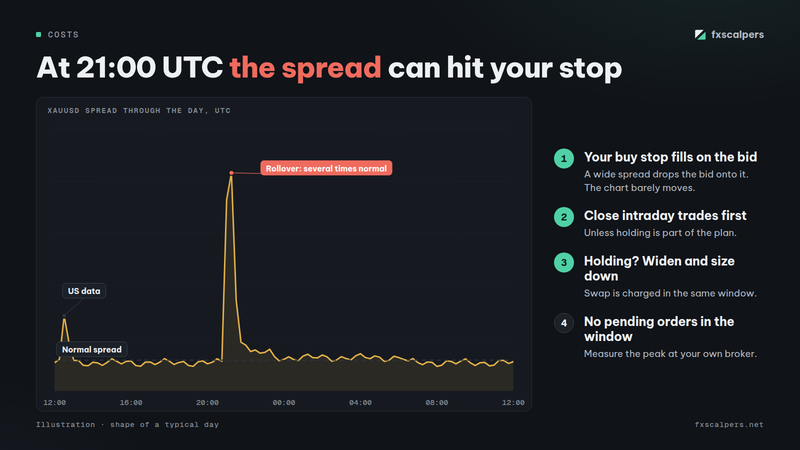
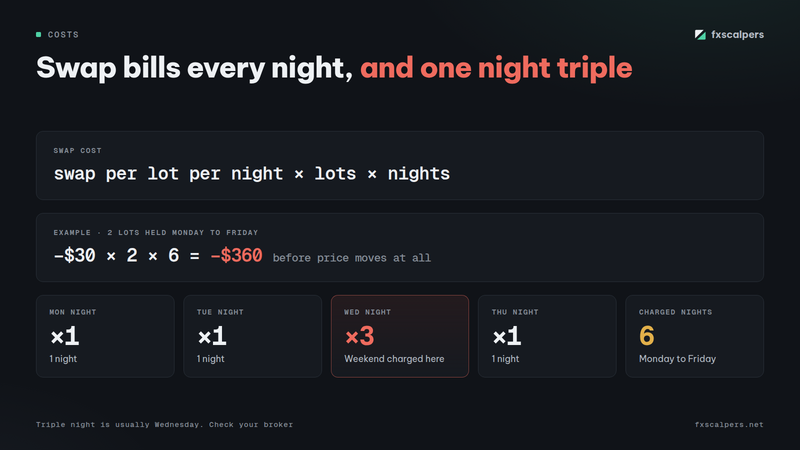
- Swap. Irrelevant for intraday trades. Very relevant for a trade that gets stuck overnight, and at many brokers gold swap is negative in both directions.
- Stop level. Not a fee, but it costs money: a large stop level blocks you from placing a tight SL or TP, forcing a wider stop than planned.
Measure, don’t ask
No broker will honestly answer “what’s your spread during news”. Here’s how to get the real number:
- Open a demo and a small live account at the broker at the same time. Demo and live spreads can differ.
- Record the spread at three moments for 10 days: 08:00 UTC, 12:35 UTC, and right at a major US release.
- Place 20 market orders of 0.01 lots while price is moving fast, then compare click price to fill price in your trade history.
After 10 days you have your real cost per lot at the hours you actually trade. That’s the number to compare brokers with.
The final comparison
Cost per lot times lots per month. A scalper trading 100 lots a month with a $5 per lot difference between two brokers is looking at $500 a month, $6,000 a year. That’s the number to put next to your expected profit. For a lot of traders, it’s bigger than the profit.
A worked example: two brokers, same trader
A scalper trades 60 lots of gold a month, a third of them around the New York open. Ten days of measurement give:
- Broker A: average spread at the trader’s hours 0.18 ($18/lot), commission $7, average slippage on fast-market orders $0.40 per ounce on a third of the lots. Cost per lot ≈ $18 + $7 + $13 = $38.
- Broker B: headline spread “from 0.0”, but 0.22 at the trader’s hours ($22/lot), commission $6, slippage $1.10 per ounce on fast orders. Cost per lot ≈ $22 + $6 + $37 = $65.
Illustrative numbers. The broker with the better advertisement costs $27 more per lot, over $1,600 a month at 60 lots. Only measurement shows it.
A simple measurement sheet
- Columns: date, time (UTC), spread at 08:00, spread at 12:35, spread at the release, click price, fill price.
- Fill it for 10 trading days on each broker you’re comparing.
- Average each column. Convert to dollars per lot (spread × 100 for gold).
- Add commission, and the rebate if you get one, and multiply by your monthly lots.
What money can’t measure
- How long withdrawals take, and whether they come with surprise document requests.
- Whether the broker has ever cancelled clients’ winning trades over “price errors”.
- Where it’s licensed. An offshore license doesn’t mean a scam, but it does mean that in a dispute, you’re mostly on your own.
The measured cost table for the brokers FXScalpers supports will be published on the Trading Costs page, with measurement dates.
Quick FAQ
Is a lower spread always better?
Only if it holds at your hours and fills are clean. A tight spread with heavy slippage costs more than a slightly wider spread with honest execution.
Does Raw beat Standard?
Usually for active traders, but run it: Raw vs Standard shows the calculation.
Want the numbers done for you? Account Support helps you pick the account that fits your volume, and the Free channel posts the setups that make those lots count.