The breakeven stop trap: when moving to BE costs you money
Moving to breakeven too early turns good trades into scratches. Why pullbacks to entry are normal, and better rules for when to move it.
Moving your stop to breakeven feels like the safest move in trading. Risk off, free trade, nothing to lose. Done too early, it’s one of the most expensive habits a scalper can have, because it turns good trades into scratches over and over, and scratches don’t pay for losers.
The short version
- Healthy moves pull back toward the entry before they continue. A breakeven stop placed too early sits exactly where price naturally breathes.
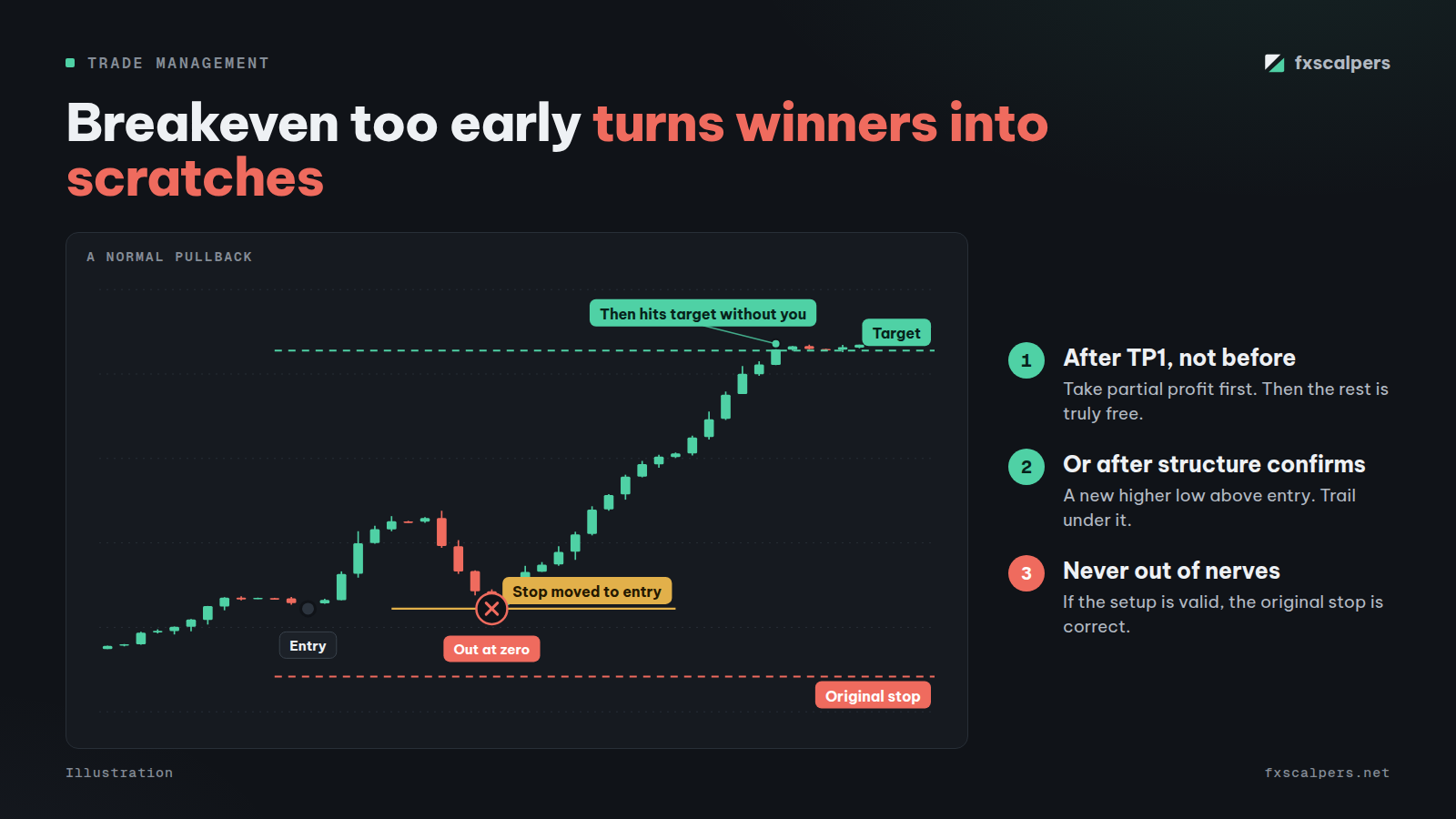
- Move to breakeven only after TP1 is hit (with partial profit taken) or after structure confirms with a new higher low (or lower high) beyond the entry.
- Never move it because you’re nervous. If the setup is valid, the original stop is correct.
How the trap works
Price moves a few pips in your favor. You move the stop to entry. Price pulls back, as it normally does, touches your entry, stops you out at zero, and then runs to your target without you. You tell yourself it was a “free trade”. It wasn’t free. It cost you the full winner.
Do that ten times a month and you’ve given away most of your winners. The strategy still has an edge on paper, but in your account it looks broken, because the trades that were supposed to pay for the losers keep ending at zero.
Why pullbacks to entry are normal
A healthy move rarely goes straight to target. It moves, pulls back, and continues. The pullback is where late buyers get in and early buyers take partial profit. If your entry sits near the start of that move, which is exactly where a good entry sits, the first pullback will often revisit it.
On gold this is even more pronounced. XAUUSD likes to retest the breakout area or fill part of an imbalance before extending. A breakeven stop there isn’t protection; it’s a standing order to exit at the worst possible moment.
The math of scratching winners
Take a setup that wins 45% of the time at 2R and loses 55% at 1R. Over 20 trades: 9 winners × 2R = +18R, 11 losers × 1R = −11R. Net +7R.
Now suppose an early breakeven stop turns just 4 of those 9 winners into scratches. 5 winners × 2R = +10R, 4 scratches = 0, 11 losers = −11R. Net −1R.
Illustrative numbers, same entries, same analysis. The only change is a stop that moved too early, and a profitable strategy became a losing one.
Better rules for breakeven
Rule 1: move to breakeven only after TP1 is hit
Take partial profit first, for example half the position at 1R. Then move the stop on the rest to entry. The trade is now genuinely risk-free and already paid for: even if the runner scratches, you banked +0.5R.
Rule 2: or move it only after structure confirms
For a buy, wait until price makes a new higher low above your entry, then trail the stop just under that low. For a sell, the mirror: a new lower high below your entry. Now the stop sits at a level that actually means something, beyond a swing the market had to respect.
Rule 3: never move it because you’re nervous
If the setup is still valid, the original stop is still correct. Nervousness usually means the position is too big for your comfort. Fix that on the next trade with the lot size calculator, not by strangling this one.
When an early breakeven does make sense
- High-impact news is minutes away and the plan says you don’t hold through it. Then the real choice is breakeven or close, and closing is often cleaner. See reading the economic calendar.
- The session is ending and you won’t be at the screen. Better still, decide in advance whether the trade is an intraday scalp or a planned swing.
- The reason for the trade has changed, for example a CHoCH against you on the entry timeframe. But then the correct action is usually to exit, not to hope for breakeven.
Check your own numbers
Go through your last 30 breakeven exits in MT5. For each one, check where price went next. If most of them later hit your original target, your breakeven rule is costing you real money and you now know roughly how much. Put it in R and log it in your trading journal.
Traps to avoid
- Breakeven plus spread. A breakeven stop on a sell triggers on the ask, and charts show the bid, so a widening spread can hit it while the chart barely moves. Buys suffer too when spreads widen in both directions. If you do move to breakeven, add a few points to cover the spread.
- Trailing too tight. Trailing one pip under every M1 candle is the same trap wearing a different outfit.
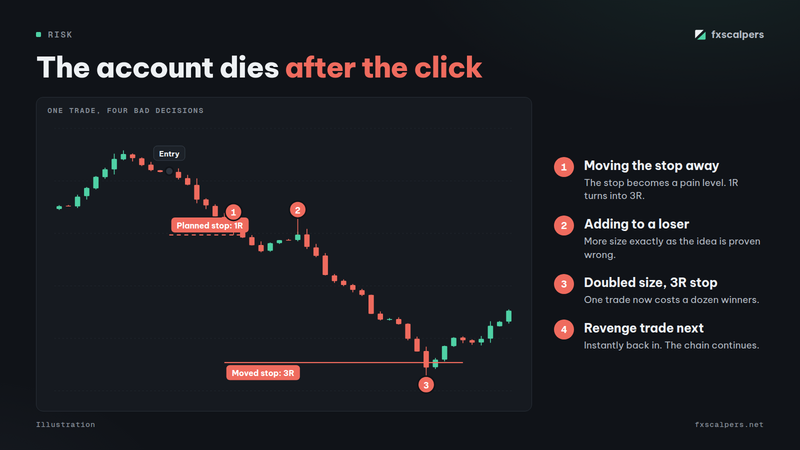
- Moving the stop in both directions. Moving it closer when scared and further away when losing is the worst combination of all. What you do after the entry covers why.
Quick FAQ
Isn’t a scratch better than a loss?
A scratch is better than a loss, but a scratched winner is worse than a winner. The question is what the stop did to trades that would have hit target.
What partial should I take at TP1?
Half is common. Whatever you choose, keep it fixed so your journal numbers stay comparable.
Setups in the Free channel come with TP1, TP2 and the follow-up: when TP1 hits and the stop moves to entry, you see it happen in real time, with the reason. Join and watch how trade management works when it follows rules instead of nerves.