Screenshots prove nothing: how to verify a trader’s results
Balances get edited and demo looks like live. What counts as real proof, what doesn’t, and the red flags inside a verified record.
A screenshot of a winning trade proves exactly one thing: that someone took a screenshot. Balances can be edited in a browser in ten seconds, demo accounts look identical to live ones, and one great week can be cropped out of a terrible year. If someone wants your money or your trust based on their results, here’s how to check them properly, in the order a professional would.
The short version
- Screenshots, balance photos, pip totals and “student results” prove nothing.
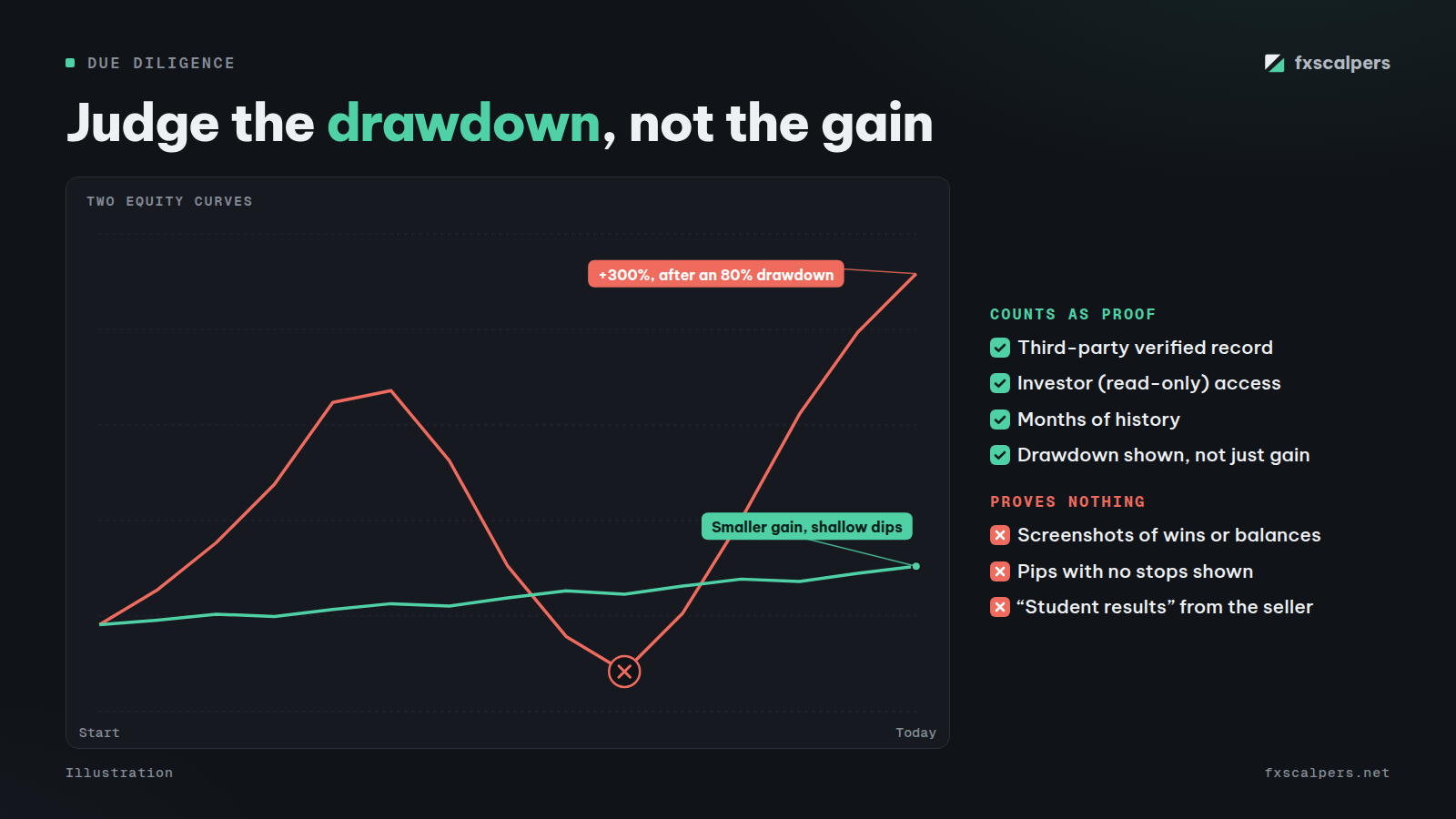
- Real proof: a third-party verified track record, investor (read-only) access, months of history, and the drawdown shown next to the gain.
- Inside a real record, look for oversizing, a few huge losses, deposits after losses and records that restart.
- Apply the same standard to everyone, including us.
What doesn’t count as proof
- Screenshots of individual winning trades. Everyone has winning trades. The question is what happened to the losing ones.
- Screenshots of an account balance. The browser developer tools can change any number on a page before the screenshot. So can an image editor.
- Results reported in pips with no stop losses shown. “+800 pips this month” means nothing without the risk behind it. 800 pips made while risking 1,200 is a losing month. On gold, the word “pip” isn’t even standardized. Why gold pips confuse everyone.
- “Student results” posted by the person selling the course. Selected, unverifiable, and often from demo accounts.
- Payout certificates alone. A prop firm payout proves one withdrawal, not a strategy. See prop firm fine print.
What does count
A third-party verified track record
Performance tracked directly from the broker by an independent service that connects to the account with read-only access. A proper verified record shows whether the account is real or demo, the full trading history, the deposits and withdrawals, and statistics calculated by the service, not by the trader.
Investor (read-only) access
MT5 lets an account owner share an investor password. With it you can log in, see every open and closed trade, the history, the balance and the equity, but you can’t place a trade. Ask for it. People with real results rarely refuse; they usually like showing it.
A long enough history
A few weeks proves nothing. Almost any aggressive approach can look brilliant for a month. Look for many months of trading through different market conditions: trending periods, ranging periods, big news weeks.
Drawdown, not just gain
A 300% return with an 80% drawdown is a lottery ticket, not a strategy. To survive an 80% drawdown you’d have needed the stomach to watch $10,000 fall to $2,000 without quitting, and the next 80% drawdown may not come back. Compare gain to maximum drawdown: a steady curve with shallow dips beats a spectacular curve with a cliff in it.
Red flags inside a verified record
- Huge position sizes relative to the balance. If a single trade can move the account 10% or more, one bad day ends it.
- Many small wins and a few enormous losses held for days. Classic sign of no stop losses and hoping losers come back. The win rate looks amazing until the day it doesn’t.
- Deposits added right after big losses. The balance curve stays pretty; the equity story is ugly.
- Grid or martingale patterns: positions added at regular intervals against the trend, sizes doubling.
- A track record that restarts from zero every few months. The old accounts blew up. The new one hasn’t yet.
- Only demo verified. Demo fills are perfect. Real ones aren’t, especially on gold during news.
A five-minute check you can run on any claim
- Ask: “Is there a verified record or investor access?” No means stop here.
- Check the account type (real or demo) and the start date.
- Find the maximum drawdown. Compare it to the total gain.
- Look at the largest losing trade relative to the average winner.
- Scan deposits and withdrawals for top-ups after losses.
Quick FAQ
Isn’t a video of the live account enough?
Better than a screenshot, still weak. Videos can show a demo, a different account, or the one good month. Continuous read-only access beats any clip.
What about signal groups?
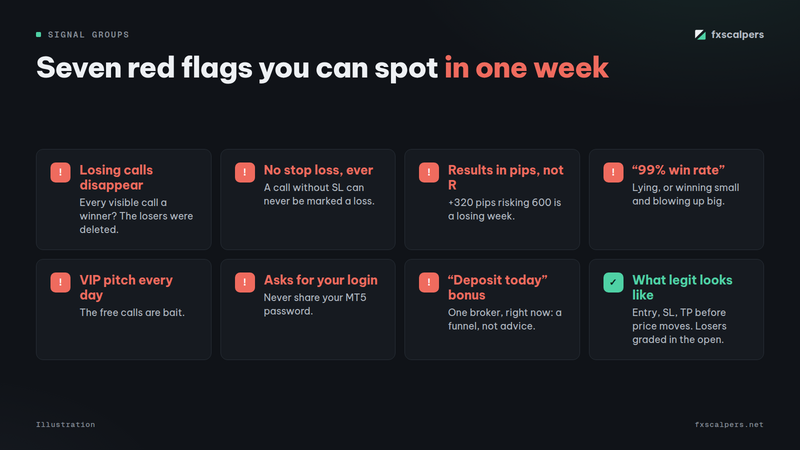
The equivalent of a verified record for a signal channel is a complete public history: every call posted before price gets there, with entry, stop and target, and every result graded, including the losses. Seven red flags of a fake signal group covers the rest.
How much drawdown is acceptable?
It depends on the style, but a drawdown larger than half the gain deserves a hard look, and any drawdown near 50% means the risk per trade is far too high for most people.
Apply the same standard to everyone
Including us. That’s why every setup in the FXScalpers Free channel is posted with entry, stop and target before price moves, and graded on the weekend scorecard, losing calls included. Nothing gets deleted, so the history is the proof. Join, watch a few weeks of calls play out, and judge the record yourself.