Prop firm challenges: the fine print that fails most traders
Equity-based daily limits, trailing drawdown, news bans, consistency rules. Read these before you pay for a challenge.
Prop firm challenges are everywhere on social media: pay a fee, pass the test, trade the firm’s capital and keep most of the profit. Some traders do get funded and paid. Many more fail on rules they never read properly, often while their trading was actually fine. Before you pay for a challenge, here’s the fine print that decides most outcomes.
The short version
- Daily loss limits are often measured on equity, so floating losses count even if the trade recovers.
- Trailing drawdown shrinks your safety margin as you make money.
- News restrictions, consistency rules, minimum days and payout conditions fail more traders than bad entries do.
- Read the terms like a contract, test the server’s spreads, and size for the rules, not for the target.
The rules that fail most traders
Daily loss limit on equity, not balance
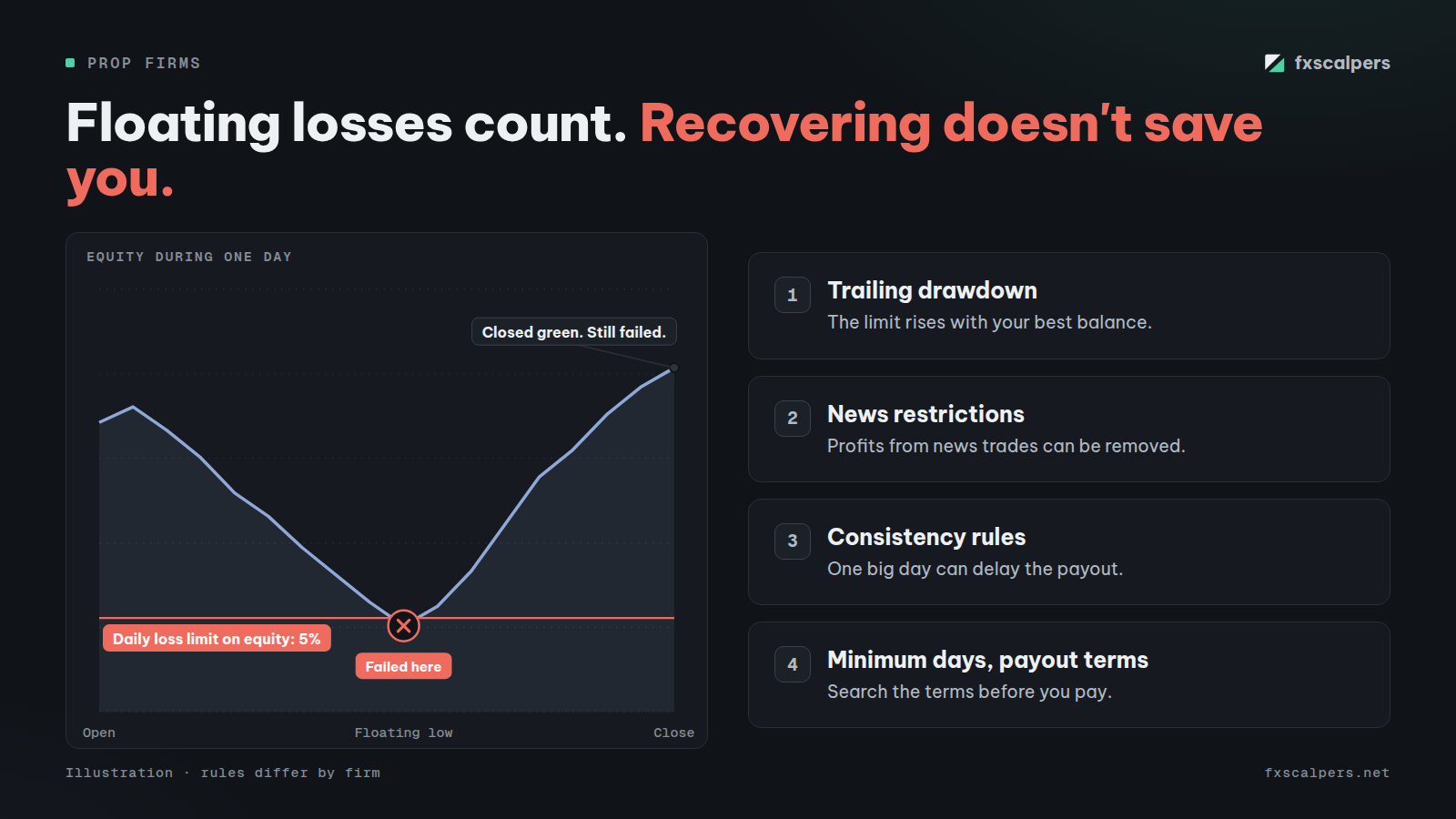
At many firms, floating losses count. A trade that dips too far into the red and then recovers can still fail you the moment it touched the limit. Picture a $100,000 account with a 5% daily limit: $5,000. You’re down $4,800 floating on two positions at 13:00, gold spikes against you for thirty seconds, equity touches −$5,050, and the account is breached. By 15:00 both trades are green and you closed the day positive. Still failed.
Also check when the day resets and what it’s measured from: the previous day’s balance, or the higher of balance and equity at the reset.
Trailing drawdown
Some firms trail the maximum drawdown up with your highest balance (or highest equity). Start with $100,000 and a $10,000 trailing limit: your floor is $90,000. Make $6,000 and the floor moves to $96,000. Your cushion is still $10,000 from the peak, but a normal pullback in a good strategy can now end the account. Some firms stop trailing once the floor reaches the starting balance; many don’t.
News trading restrictions
Opening or closing trades within a window around high-impact releases can be banned, and profits from those trades can be removed at payout time. That includes trades whose stop or target happened to hit during the window. If your style touches news hours, read this clause twice.
Consistency rules
If one day makes up too large a share of total profit, often a threshold like 30% to 50%, the payout can be delayed or denied until you trade more days to dilute it. One great CPI day can literally stall your withdrawal.
Minimum trading days
Hitting the target in two days doesn’t pass the challenge if the minimum is five. Traders then “trade the days” with small positions, and some take unnecessary risk just to fill the calendar.
Payout conditions
Waiting periods before the first withdrawal, minimum amounts, profit splits that change over time, and requirements to keep the account active. Also: rules on copy trading, EAs, hedging across accounts and holding over the weekend.
Read it like a contract
- Search the terms for “equity”, “trailing”, “news”, “consistency”, “payout”, “weekend”, “EA” and “copy” before paying anything.
- Test the trading server. Check whether spreads and commissions match what you’d get at a real broker. A scalping edge can disappear on a wide-spread server. What real trading costs look like.
- Look for real payout proof from independent traders, not the firm’s own marketing. How to verify results applies to firms too.
- Check who you’re dealing with: where the firm is registered, how long it’s been operating, and how it handles disputes.
Size for the rules
Most challenge failures are sizing failures. With a 5% daily limit and a 10% total limit, risking 2% per trade means three losses in a row nearly ends the day and five end the account. Risk 0.5% per trade and the same losing streak barely dents it.
A practical approach: set your personal daily stop at half the firm’s daily limit, risk 0.25% to 0.5% per trade, and never hold more than two positions at once. Size every trade with the lot size calculator. The target will take longer to reach. That’s fine; the account survives to reach it.
The honest math
A challenge fee is the cost of a test with strict rules. The firms that last make money from fees and from the traders who do reach payouts; the ones that don’t last were never a good bet. If your strategy can’t pass a rule set built around drawdown control, the answer is to fix the risk management, not to buy more attempts. Several failed challenges in a row often cost more than trading a small live account properly.
Quick FAQ
Are prop firms a scam?
Not by default. Some are solid, some aren’t. The rules and the payout record tell you which is which.
Can I use signals to pass?
Check the terms. Some firms restrict copy trading or identical trades across accounts. Using a setup you understand and size yourself is different from mirroring someone else.
Is a live account better?
For many traders, a small live account with strict rules is the better first step. It teaches the same discipline without a fee per attempt.
Traps to avoid
- Gambling on the last day to hit the target.
- Holding through news on a firm that bans it.
- Buying a reset immediately after failing, on tilt. The tilt checklist exists for this moment.
Whatever capital you trade, the setups in the Free channel come with a defined stop, so you can size them to any rule set. Join and practice the discipline that passes challenges before you pay for one.