Seven red flags of a fake signal group
Deleted losers, no stop losses, results in pips, a VIP pitch every day. How to spot a fake signal group in under a week.
Signal groups are everywhere, and most of them run the same playbook. Post a call, delete it if it loses, screenshot it if it wins, then sell a “VIP” upgrade to the people who only ever saw the wins. The good news: the playbook leaves fingerprints. Here’s how to spot a fake group in under a week, without risking a cent.
The short version
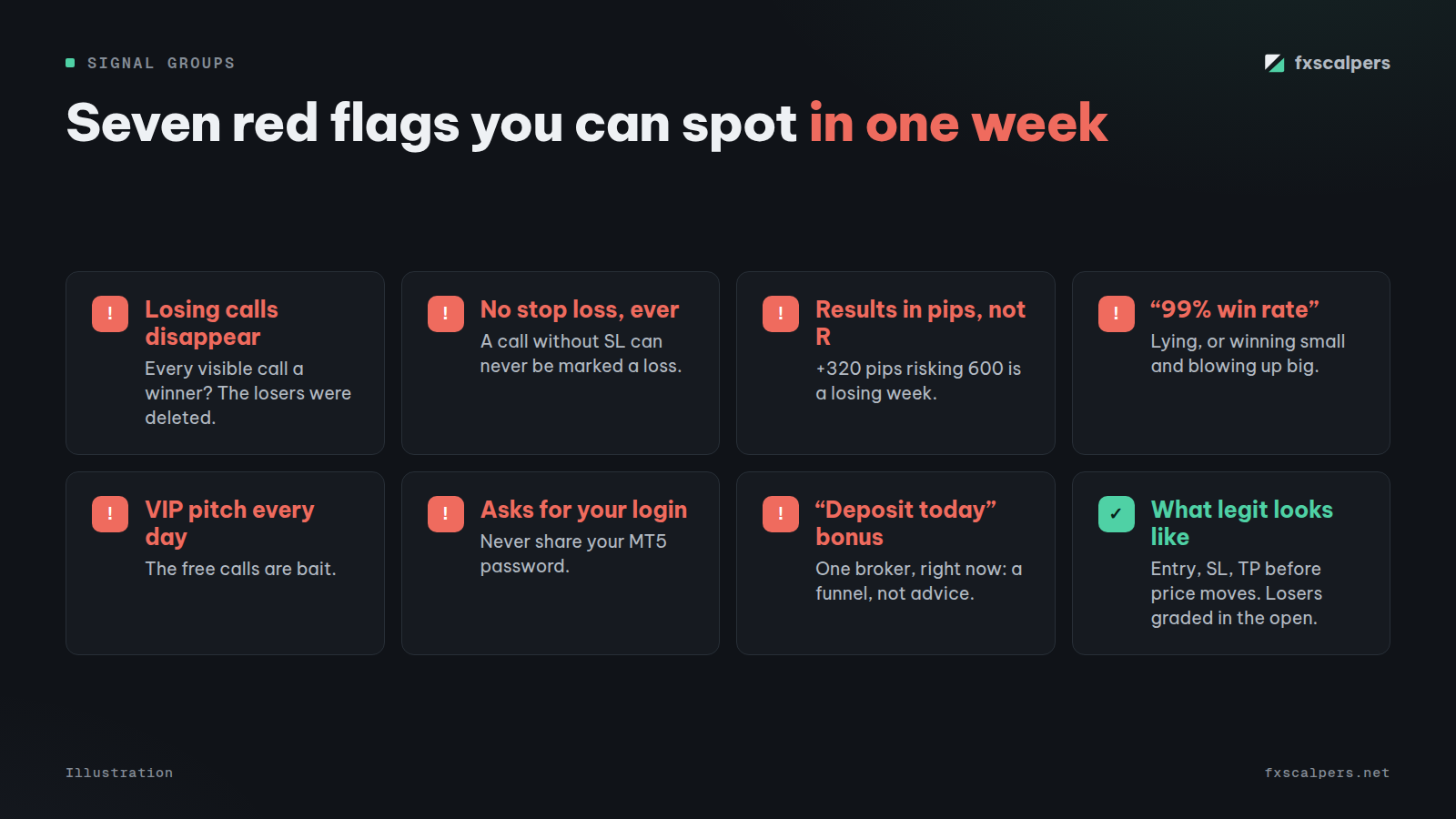
- Seven red flags: vanishing losers, no stop losses, results in pips, impossible win rates, a VIP pitch every day, requests for your login, and deposit pressure with one broker.
- A legit channel posts entry, stop and target before price moves, grades every call in public, and explains why.
- Run the one-week test before you follow anyone with real money.
Seven red flags
1. Losing calls disappear
Scroll back a week. If every visible call is a winner, the losers were deleted. No real trader has a clean week every week. Telegram shows edits and deletions only if you were watching at the time, which is exactly why the one-week test below works.
2. No stop loss, ever
A call without an SL can never be marked as a loss, because it just “hasn’t hit TP yet”. Weeks later it quietly disappears. That’s not a signal. It’s a trap for your account, and the first gold spike against it will prove it.
3. Results in pips, never in R
“+320 pips this week!” means nothing without the risk behind it. 320 pips made while risking 600 is a losing week. And on gold, pips aren’t even standardized; the same move can be reported as 5, 50 or 500 “pips”. Why gold pips confuse everyone.
4. “99% win rate” or “guaranteed profit”
Anyone who promises that is either lying or running a strategy that wins small and blows up big: no stop, tiny targets, and one catastrophic loser every few months that wipes out everything. High win rates are easy to manufacture. Positive results in R over months are not.
5. The VIP pitch comes every day
If the free channel exists mainly to advertise the paid one, the free calls are bait. Watch the ratio of trading content to sales content. When the sales posts outnumber the setups, you know what the product is.
6. Someone asks for your login
“Send your MT5 password and we’ll trade it for you.” Never. That’s how accounts get emptied, overtraded or used for somebody else’s volume. Read-only investor access for someone to review your trades is different, and even that should go only to people you trust.
7. One broker, one bonus, right now
Pressure to deposit today with one specific broker for a “limited” bonus is a sales funnel, not trading advice. Bonuses often come with withdrawal conditions buried in the terms. A real service lets you trade wherever you want and helps you choose on the numbers.
What a legit channel looks like
- Every call has entry, stop and target before price moves. Not after. Not “entry now, SL later”.
- Results are graded in the open, including the losing calls, ideally in R so different sizes compare fairly.
- The reason behind each trade is written down: the level, the structure, the invalidation. You learn something even from the losers.
- Follow-ups happen in real time: TP1 hit, stop moved, stopped out, closed early and why.
- Nobody pressures you to upgrade, deposit or share credentials.
Run the one-week test
- Join and don’t trade. Just watch for five trading days.
- For every call, note the time, market, entry, stop and target the moment it’s posted. Screenshots help.
- Check each call against the chart later. Did price reach entry? Stop or target first?
- At the end of the week, compare your notes with what the channel claims and with what’s still visible in the history.
If calls vanished, if stops appeared after the fact, or if the weekly claim doesn’t match your notes, you have your answer. It cost you nothing but attention.
Quick FAQ
Is a channel with losses a bad channel?
The opposite. Visible losses are a sign of honesty. What matters is the result over many trades, measured in R, with the risk defined up front.
Are paid groups always worse than free ones?
No. Price isn’t the test. Transparency is. A paid group that grades every call in public beats a free one that deletes its losers.
What about screenshot proof of profits?
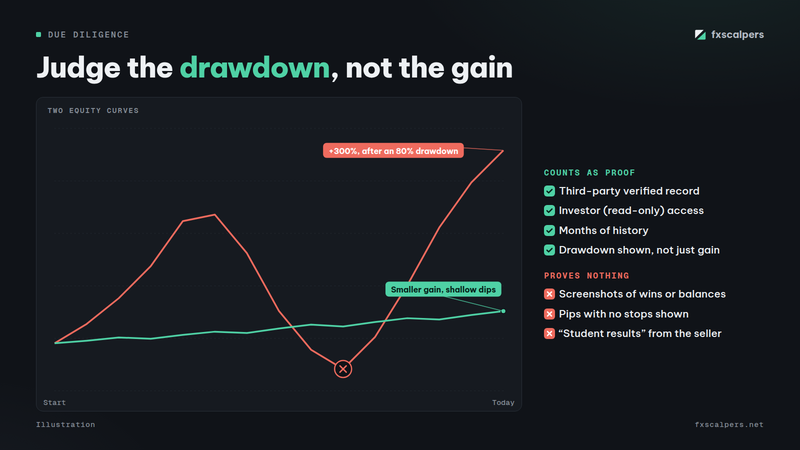
Proves nothing. Here’s what real proof looks like.
Traps to avoid
- Following a group with real money in week one.
- Copying sizes from the group instead of sizing from your own risk with the lot size calculator.
- Joining five groups at once and taking every call. That’s not diversification; it’s noise.
Hold every channel to this standard, including ours. The FXScalpers Free channel posts entry, stop and target before price moves, and grades every call on the weekend scorecard, losers included. Join and run the one-week test on us.