Bollinger Band Squeeze on EUR/USD: wait for the coil, then trade the real break
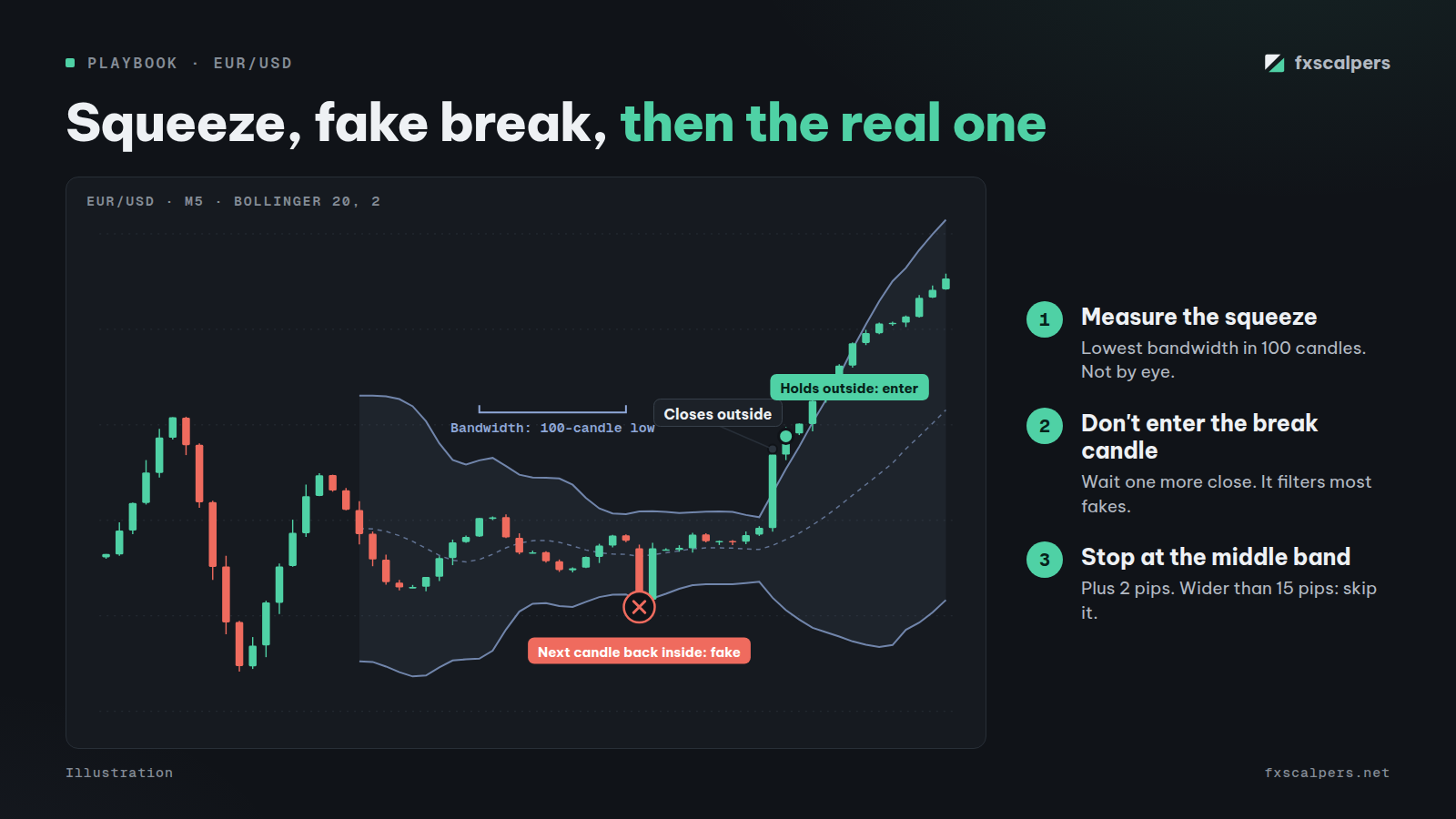
A real squeeze is measured with bandwidth, not by eye. The first break is often fake, so the rules make you wait one more candle.
When the Bollinger Bands pinch, volatility is low. Volatility never stays low for long, so a squeeze leads to a move. The hard part is that the first move out of a squeeze is very often fake. This setup lives or dies on waiting for the real one.
The short version
- A real squeeze is measured: Bollinger bandwidth at its lowest in 100 candles on EUR/USD M5.
- Don’t enter the first candle that closes outside. Wait one more close: back inside means fake, holding outside means enter.
- Stop at the middle band plus 2 pips (skip if over 15 pips), target 2R or a close back inside the band.
What a real squeeze looks like
Bollinger Bands 20, 2 standard deviations, on EUR/USD M5. Add the Bandwidth indicator. A real squeeze is when bandwidth hits its lowest reading of the last 100 candles. “Looks tight to me” doesn’t count, because bands always look tight right after a move.
Squeezes cluster at two times of day: the end of the Asian session before London (05:00 to 07:00 UTC) and the London lunch lull (10:30 to 12:00 UTC). Both happen for a reason: liquidity is waiting for the next session.
Entry rules
- A real squeeze, by the definition above.
- An M5 candle closes outside the band with a body larger than the average of the previous 10 candles.
- Don’t enter on that candle. If the next candle closes back inside the band, the breakout was rejected. Stay out.
- If the next candle holds outside or hugs the band, enter in the breakout direction on its close.
Waiting one extra candle costs you a few pips of entry price. In exchange, most fake breakouts get filtered out for free.
Stop and target
Stop at the middle band (SMA 20) plus 2 pips. If that’s wider than 15 pips, skip it: the bands have already opened up and the squeeze edge is gone.
Target 2R, or exit when price closes back inside the band, whichever comes first. Bands expanding then contracting again means the move is out of gas.
Don’t trade when
- The squeeze is sitting right before major data. The bands are tight because the whole market is waiting for the number, and the number decides the direction, not the chart. The news breakout comes with blown-out spreads and slippage.
- The squeeze forms after 15:30 UTC. There’s no session coming to push price.
A worked example
At 06:20 UTC EUR/USD bandwidth prints its lowest reading of the last 100 M5 candles: the Asian session has coiled into a 12 pip range. At 06:45 a candle closes below the lower band. Next candle closes back inside: fake break, no trade, exactly the trap the rule is built for.
At 07:10, just after the London open, a candle closes above the upper band with a body bigger than the average of the previous ten. The next candle holds outside at 1.0871. Entry on that close.
- Stop: middle band 1.0862 minus 2 pips = 1.0860. Risk: 11 pips, under the 15 pip cap.
- Target: 2R = 1.0893, or exit early if a candle closes back inside the band.
Illustrative prices. The first break cost nothing because the rules made you wait; the second one paid.
Pre-trade checklist
- Bandwidth at its 100-candle low? Measured, not eyeballed.
- Breakout candle closed outside with a larger-than-average body?
- Next candle held outside or hugged the band?
- Stop at the middle band plus 2 pips, 15 pips or less?
- No major data in the next 30 minutes, and before 15:30 UTC?
Traps to avoid
The costliest loss is the double-sided break: price breaks up, holds for two candles, you enter, then it flips and breaks down below the lower band. That’s big money sweeping both sides before committing. Once you see it in a session, stop trusting squeezes for the rest of that session.
Drill it before you trade real money
Find 40 times bandwidth hit its 100-candle low on EUR/USD M5. For each one, log the direction of the first breakout candle and where price actually went one hour later. The hit rate of that first candle will show you why the one-candle wait isn’t optional.
Quick FAQ
Why EUR/USD?
It coils cleanly before London and at lunch, and its spreads keep small breakouts profitable. On gold, squeezes break harder and the stop needs ATR-based room.
What if the second candle is a doji outside the band?
“Holds outside or hugs the band” counts. A close back inside does not.
The Free channel posts breakout setups with the confirmation rule already applied, so you see the trade after the fake, not before it. Join and let the first break trap someone else.