Scalping USD/JPY around round numbers: simple, but it takes discipline
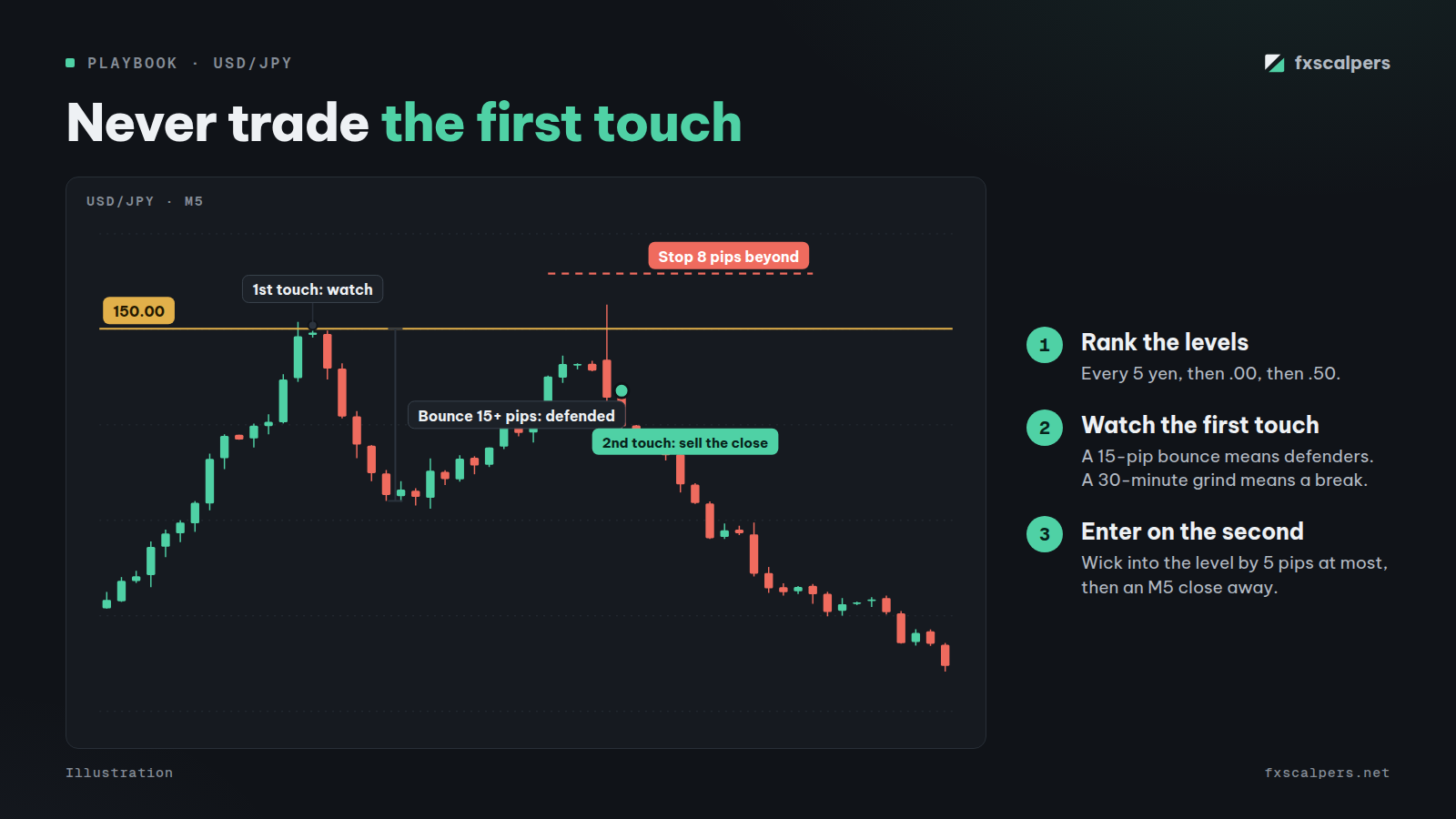
Never trade the first touch. How price reacts to it tells you whether today’s round number is a wall or a door.
USD/JPY reacts around round numbers because that’s where the whole market parks its orders: take profits, stop losses, expiring options. But “reacts” doesn’t mean “bounces”. Some days the round number is a wall, other days it’s a door. A scalper’s job is to tell which kind of day it is before entering.
The short version
- Not all round numbers are equal: every 5 yen first, then .00, then .50.
- Never trade the first touch. A 15+ pip bounce means defenders; a 30-minute grind means a coming break.
- Enter on the second touch (wick into the level by 5 pips at most, then an M5 close away), stop 8 pips beyond, target the nearest .50.
Which round numbers matter
Not every .00 and .50 carries the same weight. In order of importance:
- Every 5 yen (145.00, 150.00). Big psychological levels, quoted by the press, and historically where Japan’s Ministry of Finance has stepped in.
- Regular .00 levels.
- .50 levels. Weaker reactions, only worth trading when they line up with the previous session’s high or low.
The rule: never trade the first touch
The first time price hits a round number in a session, you just watch. The reaction to that first touch tells you who owns the level:
- Price tags it and bounces at least 15 pips: the defenders are strong. The second touch is your entry, in the direction of the bounce.
- Price tags it and grinds against the level for 30 minutes without a real bounce: the defenders are being worn down. Don’t fade it. Get ready for the break.
On the second touch, enter when an M5 candle closes in the direction of the bounce and its wick has reached or pierced the round number by no more than 5 pips.
Stop and target
Stop 8 pips beyond the round number. A 3 to 5 pip sweep through a round number is a daily routine for USD/JPY, so a 3 pip stop is a donation. Target the nearest .50 in your direction, usually 15 to 25 pips. Don’t reach for the next round number: at that distance it’s no longer a round number scalp.
Don’t trade when
- There’s a BOJ meeting, US CPI or NFP that day.
- Price is near levels where Japan has intervened before. An intervention can drop USD/JPY 400 to 500 pips in hours, and no round number holds.
- US 10-year yields are running hard that day. USD/JPY follows the yield spread, and that flow beats any technical level.
A worked example
USD/JPY rallies into 150.00 at 08:40 UTC, tags 150.01 and drops to 149.78: a 23 pip bounce. The defenders are strong. Price drifts back up and reaches 150.03 at 10:05, more than an hour after the first touch, then an M5 candle closes at 149.90.
- Entry: sell 149.90 on that close.
- Stop: 8 pips beyond the round number: 150.08. Risk: 18 pips.
- Target: the nearest .50 below: 149.50. Reward: 40 pips, about 2.2R.
Illustrative prices. Notice what you didn’t do: sell the first touch at 150.00 with a 3 pip stop, which the normal 3 to 5 pip sweep would have taken.
Pre-trade checklist
- Which level: 5-yen, .00 or .50?
- First touch bounced 15+ pips? (A grind means no bounce trade.)
- Second touch more than an hour after the first?
- Wick into the level by no more than 5 pips, M5 close away from it?
- No BOJ, CPI or NFP today, and US yields calm?
Traps to avoid
The signature loss: price touches the round number a second time, bounces exactly as planned, then turns and slices straight through. It usually happens when the second touch comes too soon, less than an hour after the first, meaning the attackers never backed off. Add the rule: two touches less than an hour apart, no bounce trade.
Drill it before you trade real money
List 30 times USD/JPY hit a .00 level in the last two months. Note how far the first touch bounced and how the second touch played out. After 30 samples you’ll have your own number for “how big a bounce makes the second touch worth trading”, instead of borrowing the 15 pips in this article.
Quick FAQ
Why USD/JPY?
Round numbers carry unusual weight there: option expiries, exporters’ orders and past intervention levels all cluster on them.
Can I trade the break instead?
Yes, when the first touch grinds without bouncing. Then treat it as a breakout and wait for a retest. Sweep or breakout covers the logic.
The Free channel flags round-number setups on USD/JPY with the first-touch reaction already observed. Join and let the level tell you who owns it.