Trend Follow M15 + Entry M5 on GBP/USD: big-picture direction, small-timeframe entry
M15 picks the direction through structure, M5 only picks the entry. Plus the signs that the M15 trend has run out.
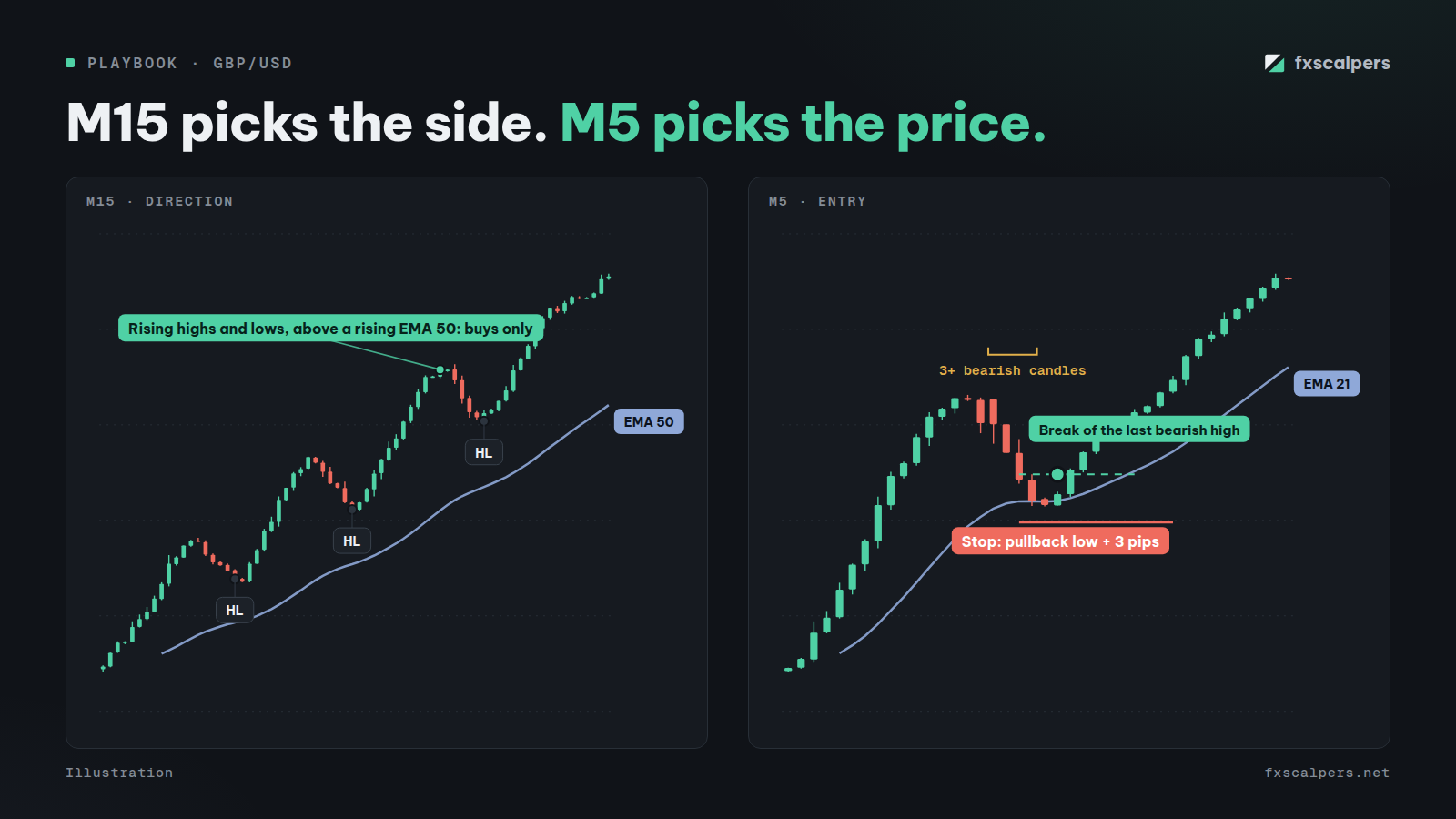
The most common scalping mistake: M5 is dropping, so you sell, while M15 is clearly trending up. That M5 drop is just a pullback inside the bigger trend. This setup forces the opposite: the higher timeframe picks the direction, the lower timeframe only picks the entry.
The short version
- M15 picks the direction: rising highs and lows and price above a rising EMA 50. Only one of the two means no trade.
- M5 picks the entry: a pullback of at least 3 bearish candles to EMA 21 or the broken M15 high, then a break of the last bearish candle’s high.
- Stop under the pullback low plus 3 pips (12 to 20 pips on GBP/USD); TP1 at the nearest M15 high.
Reading direction on M15
Use price structure first, EMA 50 only as confirmation. M15 is in an uptrend when both are true:
- The last two lows are rising and the last two highs are rising.
- Price is above EMA 50 and EMA 50 is sloping up.
Only one of the two means M15 has no direction. No direction, no setup. Close the chart.
Finding the entry on M5
When M15 is up, only look for buys on M5, and only while price is pulling back. Entry rules:
- M5 pulls back to its own EMA 21, or to the M15 high that just broke.
- The pullback has at least 3 bearish M5 candles. A 1 or 2 candle dip is too shallow and gets you buying the top.
- Enter when M5 breaks above the high of the last bearish candle in the pullback.
Sells are the mirror image when M15 is down.
Stop and target
Stop under the M5 pullback low plus 3 pips. On GBP/USD a sensible stop lands between 12 and 20 pips. Over 25 pips means the pullback went too deep and M15 structure may be breaking.
TP1 at the nearest M15 high, close half. Move the rest to breakeven and hold until M15 closes a candle below EMA 50.
When the M15 signal expires
- M15 closes below the last higher low. Structure is broken, and every M5 buy stops here.
- The M15 trend has run 3 legs without a deep pullback. Leg four is often the exhausted one, and buying the top gets likely.
- Price reaches yesterday’s high or low. Big profit-taking orders sit there. Don’t open new trades straight into it.
A worked example
GBP/USD on M15 has printed two higher lows and two higher highs since the London open, price is above EMA 50 and the EMA is sloping up. Direction: buys only.
On M5, price pulls back from 1.3478 with four bearish candles into EMA 21 at 1.3461. The last bearish candle’s high is 1.3466. The next candle breaks 1.3466: buy.
- Entry: 1.3467.
- Stop: pullback low 1.3456 minus 3 pips = 1.3453. Risk: 14 pips, inside the 12 to 20 pip band.
- TP1: the M15 high at 1.3478 area; close half there. Move the rest to breakeven.
- Runner: hold until an M15 candle closes below EMA 50.
Illustrative prices. The point is the order of decisions: direction from M15 first, then a qualifying pullback on M5, then a trigger.
Pre-trade checklist
- M15: rising highs and lows, price above a rising EMA 50? Both required.
- How many legs has the M15 trend run? Leg four deserves caution.
- M5 pullback of at least 3 bearish candles into EMA 21 or the broken M15 high?
- Stop between 12 and 20 pips? Over 25: skip.
- Room to target before yesterday’s high or low?
- Inside 07:00 to 16:00 UTC, with no high-impact release in the next 30 minutes?
Traps to avoid
The trend transition. M15 structure has just broken but EMA 50 is still sloping up out of momentum. Traders who only watch the EMA keep buying, right into the last pullback before price actually drops. That’s why structure ranks above the EMA in these rules.
Drill it before you trade real money
Pull 30 trades that follow these rules on GBP/USD over the last two months, between 07:00 and 16:00 UTC. Add one column: how many legs M15 had run at entry. After 30 trades you’ll see exactly which leg your losers cluster in.
Quick FAQ
Why GBP/USD?
It trends well during London and New York and pulls back in readable legs. The rules transfer to EUR/USD with slightly smaller stops, and to gold with dollar stops sized by ATR.
Can I use a different EMA?
The EMA is only confirmation. Structure leads. Pick a setting and keep it fixed so your journal data stays comparable.
The Free channel posts trend setups with the higher-timeframe direction stated up front, so you always know which side you’re allowed to trade. Join and let M15 do the thinking.